

Bag palletizer robot for plants in Mexico
Cement, flour, sugar, feed, chemicals. The 25 kg bag no longer rides on anyone's back.
A bag palletizer robot picks 20 to 50 kg sacks with a gripper built for that load and stacks them interlocked on a pallet. NOM-036-1-STPS-2018, Mexico's federal standard on manual handling, limits manual lifting to 25 kg for men and 20 kg for women aged 18 to 45. Target Robotics builds the palletizer in San Luis Potosí with FANUC robots.
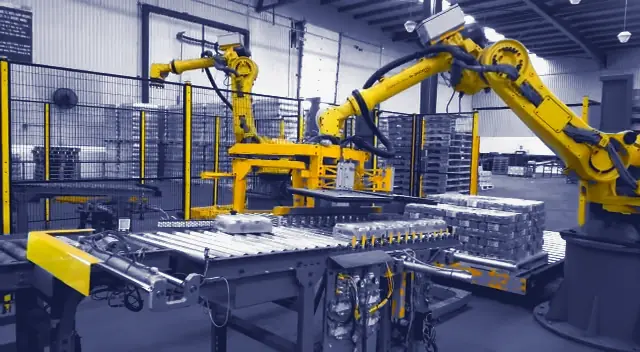
- Load
- 20 to 50 kg bagsWith a gripper built for that load
- Speed
- Based on your bags per minuteThe data sheet for each version comes with the quote
- Space
- About 6 x 6 m with fencingOrder of magnitude. The layout comes from your load and your floor
- Public price
- US$120,000 to US$550,000CSi and Kaufman, November 3, 2026
- Delivery
- 12 weeksLead time confirmed by Target, November 2026
Palletizing bags takes a different machine
A bag is soft, it deforms and it sheds dust. The gripper, the infeed conveyor and the pattern all change.
A gripper that holds from below
Forks or a claw, because on woven polypropylene and porous paper, vacuum cannot safely hold 25 kg.
Flattening before the pick
A compacting or turning conveyor evens out the bag. A flat layer depends on it.
5-bag interlocked pattern
Two lengthwise and three crosswise, reversed on the next layer. Since a bag has no corners to tie in, stability comes from the pattern.
Dust
In cement and flour, motors get protected and the cleaning interval gets shorter. The maintenance contract adjusts to that environment.
Bags and sacks: is it the same thing?
It is the same load. In Mexico it goes by three names: saco on the plant floor, where it gets palletized, and costal or bulto in the warehouse and in the field, where it gets stacked. If you searched for how to stack 25 kg bags, we have the full guide.
A 25 kg bag, 1,920 times per shift
At 25 kg per bag, a line running 4 bags per minute moves 48 metric tons in an 8-hour shift, by hand.
It is simple math: 4 x 60 x 8 x 25 kg. Getting that load off the payroll is a safety argument as well as a cost one: in 2024, IMSS, Mexico's social security institute, recorded 57,466 accidents from overexertion, travel and privation (Memoria Estadística 2024, in Spanish). Manual or robotic, row by row.
Bags of animal feed and pet food kibble
It is the same bag cell, with two extra points of care: the product settles inside the bag, and a laminated bag is smoother than woven polypropylene or paper.
In Mexico these products are called alimento balanceado (animal feed) and croquetas (kibble). Feed plants also use two words that sound almost alike: the peletizadora (pellet mill) forms the pellet and the paletizadora (palletizer) stacks the bags on the pallet.
Woven polypropylene or paper bag
Animal feed, as pellets or as meal, shifts inside the bag. It gets flattened before the pick and lifted from below, with forks.
Laminated kibble bag
It is the package that reaches the shelf, and its film is smoother. The gripper pressure is adjusted, the pattern is interlocked and, where needed, slip sheets go between layers.
Small bag
Small sizes usually travel in a bundle or a case, and the robot palletizes that unit. See cases or pouches and trays.
FANUC reference
Cells where bags are flattened and inspected before they reach the robot, and an M-410iC with fork tooling that palletizes 50-pound bags, about 23 kg, places slip sheets and sends rejected bags to their station (FANUC, in Spanish, checked November 13, 2026).
Questions about stacking bags
How do you stack 25 kg bags?
How do you stack bags of cement?
Can a robot palletize sacks?
Can a robot palletize bags of animal feed or pet food kibble?
How many bags fit on a pallet?
What is automatic bag palletizing?
Send your bag weight and your bags per minute. We reply with a version and a price range.
Delivered in 12 weeks. Public price reference: US$120,000 (CSi) to US$550,000 (Kaufman), as of November 3, 2026.
Or call sales: +52 (444) 279 0953 · WhatsApp
- 1What you palletize
- 2At what speed
- 3How many lines
- 4Your pallet
- 5How many shifts
- 6Space and city