

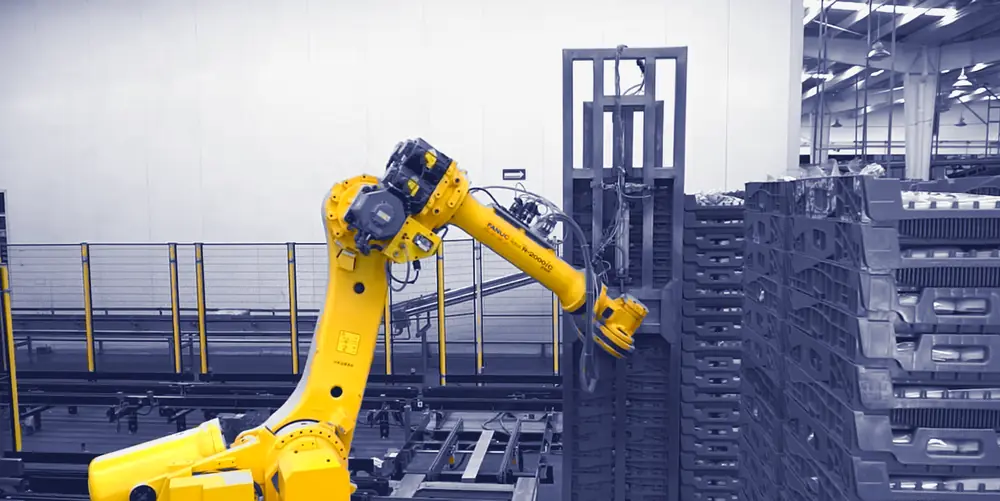
Pail palletizing robot in Mexico, also for jugs, pouches and trays
Robotic palletizing of pails, jugs, pouches and trays for plants in Mexico. With a container that is round, soft or full of liquid, the tool and the pallet pattern change.
A pail palletizing robot picks pails, jugs, pouches or trays with a tool built for that container: vacuum, fingers, gripper or forks. FANUC lists bags, pails and drums among what its robots palletize (checked November 3, 2026). Target Robotics, a Mexican palletizer manufacturer and authorized FANUC integrator, has reached 70 tubs per minute on a system with two tub models (Target video, September 17, 2020).
- Load
- Based on your full containerProduct, container and tool define the robot
- Speed
- Up to 70 tubs per minuteTarget video, September 17, 2020
- Space
- About 6 x 6 m with fencingOrder of magnitude. The layout comes from your load and your floor
- Public price
- US$120,000 to US$550,000CSi and Kaufman, November 3, 2026
- Delivery
- 12 weeksLead time confirmed by Target, November 2026
Which tool picks each container?
Each row says how the container gets picked, what happens to the layer and what public data backs it.
| Container | How it gets picked | What changes on the pallet | Public data and source |
|---|---|---|---|
| Pail or tub | Vacuum on the lid, or fingers under the rim. Plastic tubs also need orienting and stacking. | Aligned layers: the bottom of each pail nests in the lid below, and the robot needs that precision (Honeywell Intelligrated, 2018). | Target: up to 70 tubs per minute, two models at the same time, on plastic pallets and dollies (Target video, September 17, 2020). FANUC: M-410iC robot with 5-gallon pails, about 19 liters. |
| Jug (garrafón) | Gripper on the neck or body, sized for the full jug. | Slip sheet between layers, or a rack. At 27 cm in diameter, offset rows give 2 more pieces per layer than a square grid. | SIPA: 6-axis robot for 3 to 5 gallon bottles, integrated with FANUC and KUKA, with metal or plastic racks (2025). PACK'R: up to 1,200 jerrycans per hour depending on configuration, with grippers that hold without energy. |
| Bag or pouch | Forks or fingers from below if the bag is soft or porous. Vacuum with suction cups if the film seals. | Loose bag: interlocked pattern, because it deforms and has no corners to tie in. Liquid pouch: it can be loaded into a tray or case, and that unit gets palletized. | Destaco: up to 30 bags per minute, with a clamp that holds even if air pressure is lost. Vention: 30 kg maximum payload on its bag gripper (March 17, 2025). FANUC: robots that load liquid bags into trays and palletize the trays. |
| Tray | Fork from below if it is open. Vacuum with bellows suction cups if it is film-wrapped. | Rectangular, like a case: interlocked or column stack, and the cases-per-pallet calculator applies as is. | Target: system that depalletizes, orients and washes plastic trays, loads product into them, and stacks and palletizes them (Industry Era, probable date 2018). FANUC: M-410iB/700 that forms trays, loads bagged product and palletizes. |
Pages checked November 3, 2026; the data belongs to each company and serves as a reference. For Target there is a public figure on tubs and a description on trays. On pails, jugs and bags, the speed gets confirmed with your container at quote time. If your line is food or water, see palletizing by product.
When do you use vacuum, fingers, a gripper or forks?
FANUC ties the right solution to five things: product weight, shape and material, pallet pattern and end-of-arm tool.
Vacuum, when the surface seals
A smooth lid, tight film or a closed tray. FANUC shows an M-410iC with vacuum tooling for heavy cases and pails, which also moves slip sheets and pallets in the same cell. Schmalz sells its area grippers with suction cups or foam and lists boxes, bags and cans; for film-wrapped packs it uses bellows suction cups.
Fingers under the rim, when the lid gets in the way
roTeg describes three fingers that pick the pail under the edge of the lid, with no vacuum on it, and that adjust in software to other diameters (March 12, 2020).
Gripper on the neck or body, for jugs
A 2007 patent for 5-gallon bottles grabs by the neck and warns that a full bottle can overload the tool. Ask for the calculation with the full jug and the test of what happens when air fails.
Forks or fingers from below, for bags and open trays
Vention built its fork-style gripper for what vacuum cannot hold from above: open-top boxes, trays and some bags, with a 30 kg limit and 1 to 3 pieces per pick. FANUC shows an M-410iC with forks for 50-pound bags, about 23 kg. For bags that heavy, see bags and sacks.
These are references from other brands, checked November 3, 2026, useful for knowing what to ask. Target builds the tool of each robotic palletizer for your load; it can pick product, pallet and slip sheet.
What changes in the pallet pattern?
A pail or a jug leaves gaps between pieces. Three centimeters of diameter change which pattern works best and how many pieces fit per layer.
30 cm pail, in a square grid
12 per layer, with 10 cm free across the width. Each pail sits on the one below.
27 cm jug, in offset rows
14 per layer, with rows shifted by half a piece. In a square grid it would be 12.
40 x 30 cm tray, interlocked
10 per layer, with the next layer reversed. It is the same calculation as a case.
At 30 cm the square grid wins; at 27 cm, offset rows do.
Measure the pail or jug from the outside, at its widest point: at 31 cm, a row of 4 already exceeds the 120 cm of the pallet. An article by Honeywell Intelligrated (September 28, 2018) explains that the bottom of the pail nests in the lid below, and reports that going from a nine-block column stack to a nine-block pinwheel can cut by 50% the rate of a robot that picks several cases at a time. PACK'R offers slip sheets between layers as an option for jerrycans.
| Largest diameter | In a square grid | In offset rows |
|---|---|---|
| 25 cm | 16 per layer | 18 per layer |
| 27 cm | 12 per layer | 14 per layer |
| 30 cm | 12 per layer | 11 per layer |
| 31 cm | 9 per layer | 10 per layer |
Geometric calculation by Target Robotics on a 1.20 x 1.00 m pallet, flush with the edge. The strength of your container and the maximum weight of your pallet still need checking.
A 20-liter jug, 960 times per workday
At 2 jugs per minute, an 8-hour workday moves 19,200 kg by hand.
It is simple math: 2 x 60 x 8 x 20 kg, and the container still gets added on top. NOM-036-1-STPS-2018, Mexico's federal standard on manual handling, sets 10,000 kg per workday over distances under 10 m, and 20 kg per piece for women aged 18 to 45; check with your safety team how it applies to your crew. From 3 shifts with 2 people per shift, the palletizer pays for itself (Target Robotics calculation with assumptions): run the numbers with yours.
What data to gather at your plant before requesting a quote
These add to the 6 data points at the bottom of this page.
Outside measurements
Diameter, or length and width, at the widest point, and height with the lid on. A drawing helps; a full sample and an empty one help more.
Full weight
Product plus container, and how many pieces you want per pick. That sum and the tool define the robot.
Where it can be picked
Lid, neck, handle, rim or film. Flag any area that must stay untouched, like a label or a seal.
How it reaches the cell
Standing, lying down, oriented or loose, and whether it comes in rows or piece by piece.
How the pallet must leave
Rack or dolly, layers, maximum height and slip sheets. If your customer requires a pattern, send it.
What it holds and where it runs
Water, paint, chemicals or food; temperature, dust and washdown.
What to check on safety with these containers
The questions for any cell, plus the ones for a piece that can drop or spill.
The grip with no air or power
ISO 10218-2:2025 has a clause on power loss (5.2.10) and one on end-effectors (5.9). The Epson tool manual quotes ISO 10218-2, under a different clause number, saying that a failure of power, air or vacuum must avoid a hazardous release of the load (checked November 3, 2026). Ask to see the test with the full container.
The container goes into the risk assessment
The 2025 edition counts the workpiece as part of the application (foreword of the standard, February 2025). A heavier container or one more layer can move hazards, stopping times and the light curtain distance. NOM-004-STPS-1999, Mexico's federal standard on machinery safety (DOF, the official gazette, May 31, 1999, in Spanish), puts the risk study on the employer.
Stack height
NOM-006-STPS-2023, Mexico's federal standard on material storage and handling (DOF, March 7, 2024, in Spanish), requires setting it by the strength, shape and dimensions of the load (section 9.4(b)). If you stack cylinders lying down, it requires chocks on the bottom layer (section 9.4(i)).
Spills and cleanup
When a pail breaks inside the cell, someone goes in to clean up. Ask for that procedure, with energy lockout, and say from the start if the product is chemical or flammable.
Questions about palletizing pails, jugs and pouches
How do you palletize pouches?
Can a robot palletize pails?
What tool does a robot need for jugs?
How many pails or jugs fit on a pallet?
Is tray palletizing the same as case palletizing?
How much does a pail, jug or pouch palletizer cost?
Can one robot palletize several containers?
Send your container measurements, its full weight and your pieces per minute. We reply with a version and a price range.
Delivered in 12 weeks. Public price reference: US$120,000 (CSi) to US$550,000 (Kaufman), as of November 3, 2026.
Or call sales: +52 (444) 279 0953 · WhatsApp
- 1What you palletize
- 2At what speed
- 3How many lines
- 4Your pallet
- 5How many shifts
- 6Space and city