

Robotic food and beverage palletizing in Mexico
These lines run several shifts with high turnover. From 3 shifts with 2 people per shift, the palletizer pays for itself (Target Robotics calculation with assumptions).
Mexico has 1,220 food plants and 207 beverage plants with 101 or more people (DENUE, Mexico's national business directory, May 2026). Target Robotics, a Mexican palletizer manufacturer and authorized FANUC integrator, has built systems for this industry that run up to 60 cases per minute and serve 6 lines, and it delivers them in 12 weeks.
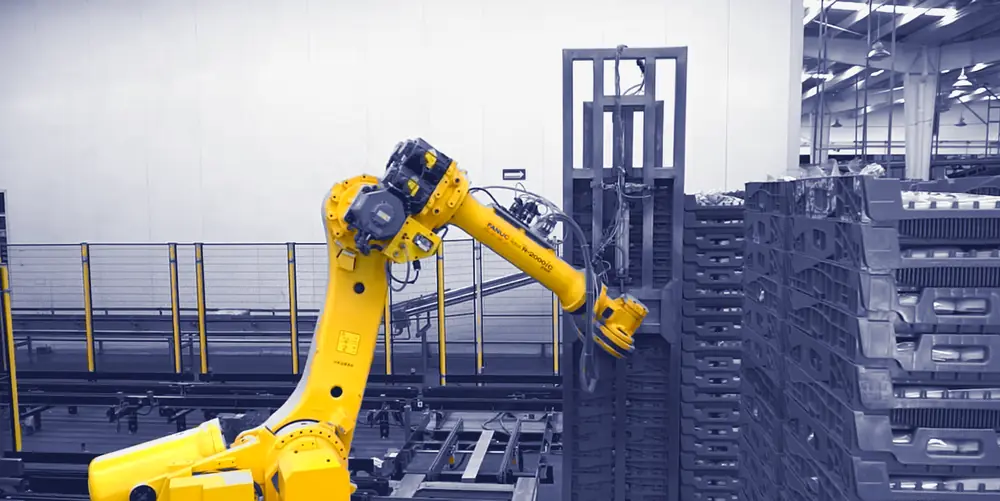
What changes by product?
| Product | What makes it hard | How it gets solved |
|---|---|---|
| Cookies and snacks | Light case and fragile product; many SKUs and changeovers | Gentle vacuum, patterns stored per product, changeover in minutes |
| Bread and plastic tubs | Tubs that stack, with empties coming back | Orienting and stacking. Target has reached 70 tubs per minute |
| Dairy | Thin packaging, high weight, cold and wet environment | Column stack patterns with slip sheets, washdown protection |
| Beer and soft drinks | High speed, heavy case, vibration in transit | Row forming, several pieces per pick, stability test |
| Water and large jugs | Weight per piece and pallet height | Gripper tool and a higher-payload robot |
| Sugar, flour and salt | 25 to 50 kg bags and dust | Bag gripper |
If your plant bags animal feed or pet food kibble, yours is a bag line: flattening before the pick, a fork gripper and an interlocked pattern. Bags of animal feed and pet food kibble.
Why does it pay off sooner on these lines?
Three shifts
Most of these lines never stop. Run the numbers with your crew.
Turnover
25% a year at manufacturers with 51 to 250 people and 31% at those with more than 250 (Censos Económicos 2019, Mexico's economic census, via Data México, cited by Tetakawi, 2026).
Workweek
The legal maximum in Mexico drops to 46 hours in 2027 and 40 in 2030, with no pay cut. What it means for your line.
Deduction
67% in 2026 and 62% from 2027 to 2030, with a certificate. What it is and what it is worth.
Questions about food palletizing
How do you palletize food products?
How do you stack beer cases on a pallet?
How do you stack cases of milk on a pallet?
Does the Plan México deduction apply to food and beverage?
Send your load, speed and shifts. We reply with a version and a price range.
Delivered in 12 weeks. Public price reference: US$120,000 (CSi) to US$550,000 (Kaufman), as of November 3, 2026.
Or call sales: +52 (444) 279 0953 · WhatsApp
- 1What you palletize
- 2At what speed
- 3How many lines
- 4Your pallet
- 5How many shifts
- 6Space and city