

Robotic palletizer manufacturer in Mexico
One replica machine, in 3 versions, built in San Luis Potosí with FANUC robots.
A robotic palletizer picks up cases, bags or tubs at the end of the line and stacks them on a pallet, layer by layer. Target Robotics, a Mexican palletizer manufacturer and authorized FANUC integrator, delivers it in 12 weeks, with a course included and a 24/7 maintenance contract in Spanish.
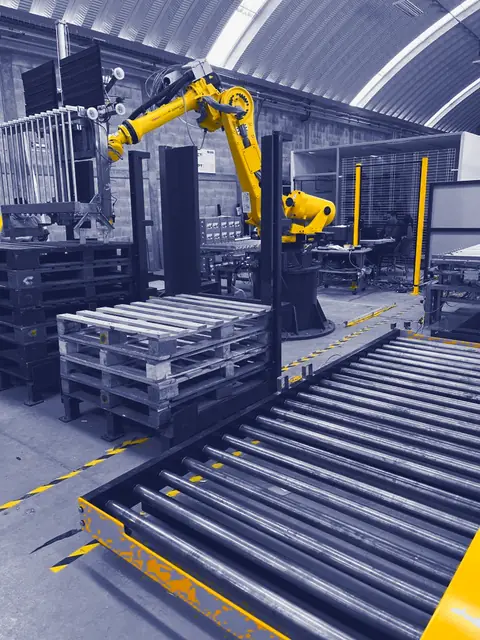
- Load
- 3 to 50 kgMMS México, 2017
- Speed
- Up to 60 cases per minuteTarget presentation, 2026
- Space
- About 6 x 6 m with fencingOrder of magnitude. The layout comes from your load and your floor
- Public price
- US$120,000 to US$550,000CSi and Kaufman, November 3, 2026
- Delivery
- 12 weeksLead time confirmed by Target, November 2026
How does a palletizer work?
Product comes in
It arrives from your line on a conveyor. It gets oriented and gathered into rows, according to the pallet pattern.
The robot picks the row
Target's tool picks the product, and the same gripper can pick up the pallet and slip sheet.
It places the layer
The robot sets each row in its place. Layer by layer, interlocking the pattern so the load does not come apart on the truck.
Full pallet out, empty pallet in
The full pallet moves on to stretch wrapping or strapping and a forklift or AGV takes it away.
One machine, three versions
You choose by what you load and how fast. Target replicates a proven machine and adapts it to your line.
| Version | For which line | Reference in installed systems |
|---|---|---|
| Low speed and load | Slow line and light cases. First automation of the stacking job | Cases from 3 kg |
| Medium speed and load | Medium speed, with cases or bags of medium weight | Up to 2 layers per minute, with a multitask tool |
| High speed and load | High speed, heavy load, several lines, 3 shifts | Up to 60 cases per minute, one system on 6 lines, cases up to 50 kg |
References from Target's corporate presentation (2026), a Target video (2024) and MMS México (December 6, 2017). The data sheet for each version, with model code, load, cycles and space, comes with the quote. See the data sheet, with plan and elevation.
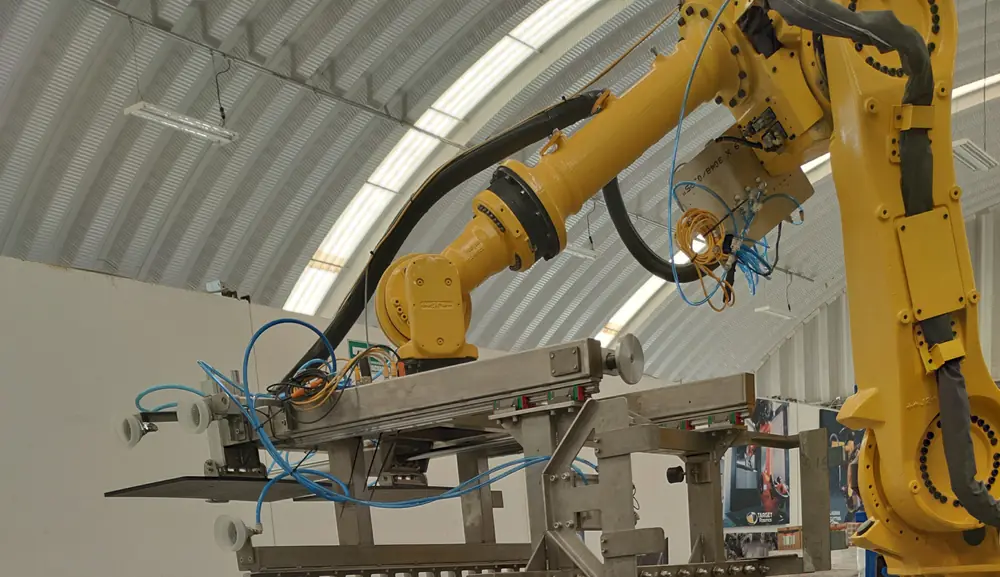
A FANUC robot with its tool, during assembly at Target's plant.
By what you palletize
- CasesCorrugated, trays and packs. Interlocked, pinwheel and column stack patterns.
- Bags and sacksCement, flour, sugar, feed. A gripper built for bags.
- Pails, jugs and pouchesTubs, pouches and trays: which tool picks each container.
- With a FANUC robotThe M-410 series and what a robot still needs to palletize.
- If you are looking for an automatic palletizerTypes, capacity and price. And how it differs from a pellet mill.
- Food and beverageCookies, dairy, beer and water.
- Cement and building materials25 to 50 kg bags in dusty environments.
- Personal care, household and chemicalsCases of bottles, jugs, pails and detergent bags.
- End of lineFrom the case erector to the AGV: what comes before and after the palletizer.
What types of palletizing are there?
Before you ask for a price, check which one fits you: the last row of the table says where each one makes sense.
| Manual | Cobot | Industrial robot | Conventional or Cartesian | |
|---|---|---|---|---|
| Typical speed | 8 to 10 cases per minute, dropping to 5 or 6 by the end of the shift | 8 to 13 cycles per minute | 15 to 60 cases per minute, depending on the tool | High on full layers: from 15 to 20 cases per minute (Automation Distribution) up to 200 (Seraphim Vietnam, January 2026) |
| Load per piece | 25 kg men, 20 kg women (NOM-036, Mexico's manual handling standard) | Up to about 35 kg | Up to 50 kg for cases; more with a layer tool | Depends on the machine |
| Space | Little | Little, with no fence in some applications | Fenced cell, about 6 x 6 m | A lot, and fixed |
| Product changeover | Immediate | Reprogrammable | Reprogrammable, several patterns | Slow, mechanical adjustments |
| Public reference price | Payroll | From US$85,000 (Robotiq) | US$120,000 to US$550,000 (CSi and Kaufman) | US$200,000 to US$600,000 (Seraphim Vietnam) |
| Where it makes sense | One shift, low volume | First automation, 1 or 2 shifts, light loads | 2 or 3 shifts, large crew, several products | A single case size, very high volume |
Public figures from each source, checked November 3, 2026; some are from the United States. Manual: Seraphim Vietnam, January 2026. Cobot: Automation Distribution and Robotiq. Industrial robot: Target presentation, 2026, and public spec sheets. The 6 x 6 m cell is an order of magnitude: your layout comes from your load and your floor.
What you can verify
Mexican palletizer manufacturer and authorized FANUC integrator.


| FANUC | Authorized integrator since 2003, level 5 in Mexico. FANUC Excellence Award 2017. Listed with Packing/Palletizing (copy of the Mexico list, January 17, 2026). |
|---|---|
| KUKA | Official System Partner, with Palletizing/Packaging in KUKA's partner finder (November 3, 2026). |
| Safety | Safety functions designed in accordance with ISO 13849-1. Control panels built under the UL 508A program. Which documents to ask for. |
| Track record | Brand in use since January 9, 2001 (IMPI, Mexico's trademark office). First palletizer in 2009. An average of 50 robots integrated per year. |
| Reviews | 4.7 from 24 reviews on Google (November 3, 2026). |
Questions about robotic palletizers
What is a robotic palletizer?
How does a palletizer work?
What types of palletizing are there?
Which companies install robotic palletizers in Mexico?
What is the difference between a robotic palletizer and a palletizing system?
Can one palletizing robot serve several lines?
Send your load, speed and shifts. We reply with a version and a price range.
Delivered in 12 weeks. Public price reference: US$120,000 (CSi) to US$550,000 (Kaufman), as of November 3, 2026.
Or call sales: +52 (444) 279 0953 · WhatsApp
- 1What you palletize
- 2At what speed
- 3How many lines
- 4Your pallet
- 5How many shifts
- 6Space and city