

Pallet requirements for distribution centers in Mexico: height, weight, wrap and chargebacks at Walmart and Amazon
Walmart de México asks for a 1.20 x 1.00 m pallet, up to 800 kg, with 4, 3 and 4 turns of stretch film and a height of 1.60 m for supermarket formats, 1.20 m for Sam's Club and 1.80 m for perishables (Annex V5, version D2, file dated October 30, 2025). Amazon Mexico asks for a 100 x 120 cm wooden pallet, up to 180 cm including the pallet and 726 kg, with 5, 3 and 2 layers of film, and at least 5, 3 and 5 on heavy and bulky shipments (Seller Central, checked November 27, 2026).
- Topic
- Pallets and stacking
- Reviewed
- November 27, 2026
- Reading time
- 10 minutes
The pallet requirements for distribution centers in Mexico that are public: Walmart asks for a 1.20 x 1.00 m pallet, 800 kg and a height of 1.60 m for supermarket formats, 1.20 m for Sam's Club and 1.80 m for perishables (Annex V5, October 2025); Amazon Mexico, 180 cm and 726 kg (Seller Central, checked November 27, 2026). Insufficient stretch film costs 2 days of UMA: MXN 234.62 at INEGI's 2026 UMA, in a Target Robotics calculation.
In this article
- Pallet requirements for distribution centers in Mexico
- What is the pallet height limit at each CEDIS in Mexico?
- How much does Walmart charge for a badly delivered pallet?
- What pallet label does GS1 Mexico ask for?
- Retailers with no public receiving rules
- Why does a CEDIS reject a pallet?
- What changes when a robot builds the pallet?
- How to bring these requirements to your line
“Merchandise must be delivered stacked with 4 turns of stretch film at the bottom and top of the pallet, 3 turns in the middle section.” That is item 2 of Annex V5, version D2, from Walmart de México y Centroamérica, in our translation. The next page carries the charge for insufficient film: 2 days of UMA, Mexico’s inflation-indexed unit for fees and fines, deducted from the invoice. Whoever receives the pallet writes the pallet requirements for distribution centers in Mexico, known locally as CEDIS, and they change from one retailer to the next and between store formats of the same retailer.
This article covers what each retailer keeps in public view, with the document version and the date we checked it, November 27, 2026. Retailers change these annexes: the current version your buyer hands you governs. Stacking height inside your plant, the subject of NOM-006-STPS-2023, Mexico’s federal standard on storing and handling materials with machinery, is in the pallet and stacking guide for Mexico.
Pallet requirements for distribution centers in Mexico
Walmart links its contract template from its supplier page. Annex V5, the agreement for centralized deliveries and logistics operations, covers Bodega Aurrera, Bodega Aurrera Express and Walmex (Supercenter, Express, Sam’s, Mi Bodega, Ecommerce and DSV), and the published file is dated October 30, 2025. For pallets, the Walmart document that sits in the open is this annex to its supplier contract, in Spanish. Amazon Mexico publishes its pallet requirements in Seller Central help, under seller requirements for less-than-truckload deliveries, a page with no visible date.
| Requirement | Walmart de México (Annex V5, version D2) | Amazon Mexico (Seller Central) |
|---|---|---|
| Pallet | Standard 1.20 x 1.00 m, in good condition or from a supplier approved by Walmart | Wood, 100 x 120 cm, access on all 4 sides, GMA grade B or better; food, GMA grade 1A only |
| Maximum height | 1.60 m for supermarket formats (autoservicio), 1.20 m for Sam’s Club and 1.80 m for the perishables network | 180 cm, pallet included |
| Maximum weight | 800 kg per pallet | 726 kg in total |
| Stacking | Delivered in a single stack; the load may not exceed the surface of the pallet | Single-stacked pallets only; merchandise cannot overhang the edge of the pallet |
| Stretch film | 4 turns at the bottom, 3 in the middle and 4 at the top, from the base upward | 5 layers at the bottom, 3 in the middle and 2 at the top, with a note reading “No romper playo”; only heavy and bulky shipments must carry at least 5 x 3 x 5 |
| Identification | Package contents clear and legible; for perishables, one product per pallet, with item number and total units | Pallet label on all 4 sides, outside the film; a label on each case; multiple SKUs, physically separated |
| If the delivery fails | Charges in days of UMA deducted from the invoice | A broken or damaged pallet is rejected and the seller pays the costs |
Amazon counts the pallet inside its 180 cm, and adds that the load must stay stable once the film comes off. Annex V5 leaves open whether its 1.60 m includes the wood. Ask at the packaging review: GS1 Mexico’s guide to selling at Walmart (August 2024) says to book an appointment with the Revisión Óptima de Empaque (packaging review) area at the CEDIS to agree on delivery conditions.
What is the pallet height limit at each CEDIS in Mexico?
Height decides how many layers travel on each pallet. In a single item, Walmart sets three heights for the 1.20 x 1.00 m pallet: 1.60 m for supermarket formats, 1.20 m for Sam’s Club and 1.80 m for the perishables network. The same case gives a different pallet for each destination:
| Destination | Published limit | Layers | Cases | Weight with pallet |
|---|---|---|---|---|
| Sam’s Club | 1.20 m | 4 | 40 | 505 kg |
| Walmart supermarket formats | 1.60 m | 5 | 50 | 625 kg |
| Walmart perishables network | 1.80 m | 6 | 60 | 745 kg |
| Amazon Mexico | 180 cm and 726 kg | 5 | 50 | 625 kg |
This is a Target Robotics calculation with assumptions: a 40 x 30 x 26 cm case weighing 12 kg, 10 cases per layer, a 1.20 x 1.00 m pallet that stands 15 cm tall and weighs 25 kg, zero overhang and the pallet counted inside the height. With that case, the sixth layer fits within Amazon Mexico’s 180 cm and takes the pallet to 745 kg, above its 726 kg limit. From 1.80 m down to 1.20 m the pallet goes from 60 to 40 cases, a third fewer for every pallet position on the truck.
For your own case, the cases-per-pallet calculator lets you set the maximum total height and the pallet height; the method by hand is in how many boxes fit on a pallet.
How much does Walmart charge for a badly delivered pallet?
Annex V5 lists its charges for failures in the delivery of merchandise, the supplier chargebacks. They are set in days of UMA and, per the annex, deducted from the supplier’s invoicing, plus VAT (IVA). INEGI, Mexico’s statistics agency, set the daily UMA at MXN 117.31 from February 1, 2026 (press release 1/26, January 8, 2026).
| Failure, per Annex V5 | Charge, in days of UMA | In pesos, before VAT |
|---|---|---|
| Merchandise with no stretch film or insufficient film | 2 | MXN 234.62 |
| Re-palletizing, per pallet | 6 | MXN 703.86 |
| Re-palletizing because of a damaged pallet | 9 | MXN 1,055.79 |
| Missing the appointment or canceling it with less than 24 hours’ notice | 15 | MXN 1,759.65 |
| Unloading of palletized merchandise | 15 | MXN 1,759.65 |
| Rejection over poor merchandise quality | 60 | MXN 7,038.60 |
| Unloading of floor-loaded merchandise | 60 | MXN 7,038.60 |
The peso column is a Target Robotics calculation at the 2026 daily UMA: days of UMA times MXN 117.31. For the perishables network, the annex drops the charge for palletized unloading and bills rejection over poor quality at a cost per case moved. The text leaves open whether the film charge runs per pallet or per delivery.
A truck with 20 pallets that need re-palletizing adds up to MXN 14,077.20 before VAT, at the 2026 UMA. The math, on that assumption, is 20 x 6 x 117.31. The UMA is updated every year, and the charge in pesos moves with it.
Amazon Mexico publishes no fee schedule on those pages. It states that a broken or damaged pallet is rejected at the seller’s cost, and that a shipment refused at the dock is returned at the sender’s expense (shipping and routing requirements, checked November 27, 2026).
What pallet label does GS1 Mexico ask for?
The GS1 Logistic Label Guideline, which GS1 Mexico publishes in Spanish (release 1.3, ratified July 2019), identifies each pallet with an SSCC, the Serial Shipping Container Code. The company that builds the logistic unit assigns it, with its own GS1 Company Prefix. The SSCC, 18 digits long, is the only mandatory element of the GS1 logistic label. On where the label goes, the guideline carries three rules:
- Height (rule 8-1): the barcode sits between 400 and 800 mm from the base of the pallet.
- Edges (rule 8-2): the symbol stays at least 50 mm from any vertical edge.
- Sides (rule 8-3): labeling two sides of the pallet with the same data is recommended.
Walmart’s Annex V5 makes no mention of the SSCC, and Amazon uses its own pallet labels. The GS1 guideline applies when your retailer asks for a logistic label.
Retailers with no public receiving rules
In our search on November 27, 2026 we found no pallet requirements document open to the public on the sites of Chedraui, Soriana, La Comer, H-E-B, Costco Mexico or Oxxo. Copies of manuals circulate on third-party sites; they are left out here, because their version cannot be confirmed. At those retailers each supplier’s agreement governs, and you request it from your buyer or the logistics area.
Liverpool keeps in public view a manual for measuring merchandise (version 5.2, 2019) with a single pallet figure: a 2.60 m maximum height for deliveries to its Tultitlán distribution center.
Why does a CEDIS reject a pallet?
Six causes repeat between Annex V5 and the Amazon Mexico pages:
- Height or weight above the limit. Both documents set both limits.
- Overhang. Both retailers ask for the load inside the surface of the pallet.
- Broken or damaged pallet. Walmart charges 9 days of UMA to re-palletize it and Amazon rejects it.
- Loose or scant stretch film. Walmart charges 2 days of UMA; Amazon asks that the film fully secure the product to the pallet.
- Illegible or misplaced label. Amazon lists incorrectly labeled shipments among the common problems that lead to rejection.
- Mixed pallet with no notice. Amazon asks you to separate the SKUs and mark the pallet “Varios SKU”, multiple SKUs; Walmart asks for one product per pallet in perishables.
Of those six causes, height, weight, overhang and product mix are decided when the pallet is built. Stretch film and the label go on at the next station, and the wooden pallet is inspected before loading. We found no public figure for how many pallets are rejected in Mexico for these causes. Your plant’s figure comes from your debit notes and return freight bills.
What changes when a robot builds the pallet?
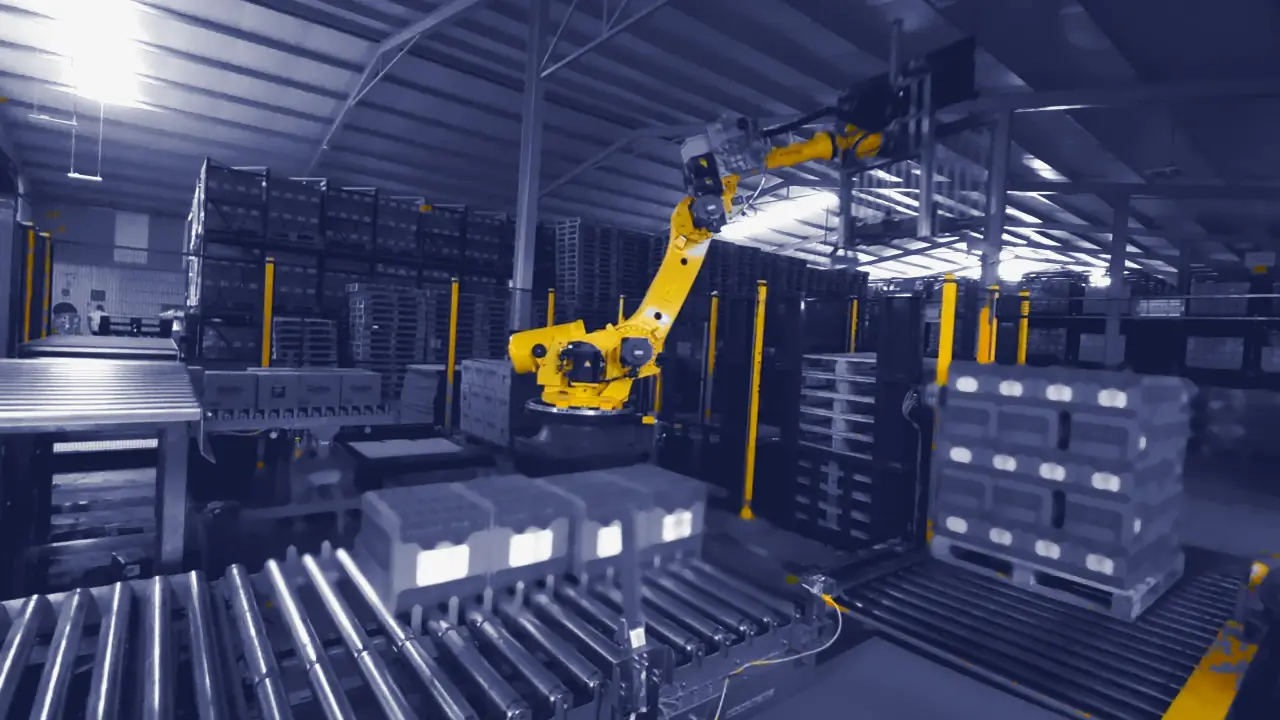
A robotic palletizer works from a recipe for each product: the pattern of each layer, the number of layers and, with them, the final height. FANUC America describes its PalletTool software as controlling the palletizing pattern, and PalletPRO as building the unit load on a computer and downloading it to the robot controller (checked November 27, 2026). For CEDIS receiving, that gives four capabilities:
- The same arrangement on every pallet. The robot can set each case in the position the pattern calls for, shift after shift.
- Height and layer count fixed by recipe. With the example case, 4 layers for Sam’s Club and 5 for supermarket formats; the operator picks the recipe for the order.
- Load flush with the edge. The pattern is programmed with zero overhang, as both retailers ask.
- Slip sheet when the customer asks for one. On that page FANUC shows an M-410iC placing slip sheets while palletizing bags.
The case and the wooden pallet remain the plant’s job. Ask your corrugated supplier for the compression strength of your case, and inspect every empty pallet before loading it: 6 or 7 boards on top, at least 4 on the bottom and access on all 4 sides, as Amazon describes for GMA grade B; for food it asks for GMA grade 1A, with 7 boards on top and 5 on the bottom. The compression lost to misalignment and to overhang is measured in how to palletize boxes, and the turns of film are in how to stretch wrap a pallet.
A disclosure: Target Robotics builds palletizers with a FANUC robot in San Luis Potosí, in 3 versions. The case palletizer robot page says which data a quote needs.
How to bring these requirements to your line
- Ask each retailer for its current annex. With version and date. Ask whether the height includes the pallet and whether the weight includes the wood.
- Fix the height in the recipe. One per destination, with the layer count from the calculator and the weight checked against the limit.
- Measure the year’s rejections and charges. Add up the debit notes for stretch film, re-palletizing and missed appointments, plus return freight, and set them beside the payroll figure in cost of manual palletizing in Mexico.
Before you draw the pattern, have the logistics annex signed with each retailer on the table. At Walmart that is Annex V5: the one published on November 27, 2026 is version D2, in a file dated October 30, 2025.
Frequently asked questions
What do distribution centers in Mexico require to receive a pallet?
My truck was sent back for tall pallets. What is the maximum height?
A re-palletizing charge was deducted from my invoice. Where does it come from?
How many turns of stretch film do Walmart and Amazon ask for?
Do Chedraui, Soriana or La Comer publish their pallet requirements?
Sources
- Walmart de México y Centroamérica, Annex V5, version D2, agreement for centralized deliveries and logistics operations, file dated Oct 30, 2025, checked Nov 27, 2026 (in Spanish)
- Walmart de México y Centroamérica, supplier page on how to apply, checked Nov 27, 2026 (in Spanish)
- Amazon Seller Central Mexico, seller requirements for less-than-truckload deliveries, checked Nov 27, 2026 (in Spanish)
- Amazon Seller Central Mexico, shipping and routing requirements, checked Nov 27, 2026 (in Spanish)
- INEGI, press release 1/26, Unidad de Medida y Actualización (UMA), Jan 8, 2026 (in Spanish)
- GS1, GS1 Logistic Label Guideline, release 1.3, ratified July 2019, Spanish edition published by GS1 Mexico, checked Nov 27, 2026
- GS1 Mexico, guide to selling at Walmart, August 2024, checked Nov 27, 2026 (in Spanish)
- Liverpool, supplier manual on merchandise measurements, version 5.2, 2019, checked Nov 27, 2026 (in Spanish)
- FANUC America, palletizing page, checked Nov 27, 2026 (in Spanish)