

IMSS work risk premium: how a back injury from manual handling moves what your plant in Mexico pays
In Mexico, low back pain counts as a work risk when IMSS, the social security institute, rules it a work accident caused by an effort on the job or an occupational disease in the table of Article 513 of the Federal Labor Law. Its subsidized days enter the formula for the work risk premium (prima de riesgo de trabajo): each day adds 2.3 days of average base salary to the following year's contribution (Target Robotics calculation).
- Topic
- Standards and safety
- Reviewed
- November 27, 2026
- Reading time
- 10 minutes
Low back pain is a work risk in Mexico when IMSS rules it a work accident or an occupational disease in the table of Article 513 of the Federal Labor Law (DOF, Dec 4, 2023). IMSS recorded 3,372 dorsopathies as occupational diseases in 2025 (2025 Statistical Report). Under Article 72 of the Social Security Law, 10 subsidized days in a 100-person plant raise the IMSS work risk premium from 0.500% to 0.563%, per a Target Robotics calculation.
In this article
- When does low back pain count as a work risk in Mexico?
- How many back injuries does IMSS record?
- How the IMSS work risk premium is calculated
- Which cases enter the formula, and on what dates?
- Example: one low back pain case in a 100-person plant
- What does a work injury cost the company in Mexico?
- What lowers the risk of manual handling back injuries
- What to ask human resources for before February
Ten days of disability leave for low back pain, in a plant of 100 people, raise the IMSS work risk premium from 0.500% to 0.563% (Target Robotics calculation with assumptions, worked out below). The premium, the prima de riesgo de trabajo, is the rate each employer pays IMSS, Mexico’s social security institute, for work risk insurance. A back injury reaches it this way: the days IMSS subsidizes enter the formula each company uses to set its premium in February, and that premium applies for a year to the salary of the entire workforce.
Payroll for the stacking crew has its own article: cost of manual palletizing in Mexico.
When does low back pain count as a work risk in Mexico?
Mexico’s Federal Labor Law (Ley Federal del Trabajo) defines work risks as the accidents and diseases that occur in the course of work or because of it (Article 473, current text with last amendment on May 14, 2026). Low back pain can come in through either route:
| Route | What the law says | Example on a stacking line |
|---|---|---|
| Work accident | Injury produced suddenly in the course of work or because of it (Article 474) | Pain appears while lifting a bag |
| Occupational disease | Pathological condition from the continued action of a work-related cause (Article 475), listed in the table of Article 513 | Pain sets in after months of lifting |
The table of occupational diseases in Article 513 was updated in the DOF, Mexico’s official gazette, on December 4, 2023, and it carries two items for the back. Item 101, disorders of the spine, names drivers, delivery workers, heavy machinery operators, loaders and security guards, along with people who hold forced postures for long periods. Item 102, chronic nonspecific low back pain, repeats those occupations and adds heavy effort on the lumbosacral part of the spine.
On both routes, IMSS makes the ruling: its medical staff evaluates whether the disability comes from a work risk or from a general illness (Report to the Federal Executive and Congress 2025-2026, chapter III). Low back pain enters your company’s account once IMSS rules it a work risk.
How many back injuries does IMSS record?
The IMSS 2025 Statistical Report (Memoria Estadística) records 644,279 work risks in 2025 among 22,042,231 insured workers: 432,929 work accidents, 191,547 commuting accidents and 19,803 occupational diseases (table VII.33). The back shows up in two counts that are read separately: accidents and diseases.
| 2025 figure | Cases | Table |
|---|---|---|
| Work accidents to the abdomen, lower back, lumbar spine and pelvis | 30,652, 7.1% of the total | VII.13 |
| Work accidents from overexertion, travel and privation | 60,670, 14.0% and the third external cause | VII.23 |
| Work accidents among loaders (cargadores) | 8,082; 2,172 from overexertion | VII.21 |
| Dorsopathies as an occupational disease | 3,372, 17.0% and the leading cause | VII.38 |
| Permanent disabilities from dorsopathies, reassessments included | 3,020 of 12,137 from occupational disease | VII.10 |
Dorsopathies, the group of spine conditions in the ICD-10 classification, went from 1,811 cases in 2021 to 3,372 in 2025, 86% more (Target Robotics calculation with table VII.38). Dorsopathies are the leading occupational disease IMSS records, and they grew 86% between 2021 and 2025.
Among loaders, 208 of the 400 occupational diseases in 2025 were dorsopathies (table VII.28), and 27% of their accidents came from overexertion, against 14% nationwide (Target Robotics calculation with table VII.21). IMSS groups its data by occupation and by injury, with no line for palletizing: these figures give context, and your plant’s cost comes from your own cases.
How the IMSS work risk premium is calculated
Article 72 of the Social Security Law (Ley del Seguro Social, current text with last amendment on January 15, 2026) gives the formula:
Premium = [(S/365) + V × (I + D)] × (F/N) + M
| Letter | What it is | Value |
|---|---|---|
| S | Subsidized days of temporary disability | From your cases closed in the year |
| I | Sum of the permanent disability percentages, divided by 100 | From your cases |
| D | Deaths | From your cases |
| V | Average years of working life | 28 |
| F | Premium factor | 2.3, or 2.2 with an occupational safety management system accredited by the STPS, Mexico’s labor ministry |
| N | Average number of workers exposed to the risk | Days of contributions for the whole workforce, divided by 365 |
| M | Minimum risk premium | 0.005, which is 0.5% |
In plain terms, the formula converts everything into years of work lost: subsidized days are divided by 365, each percentage point of permanent disability counts as 0.28 years and each death as 28.
The resulting percentage applies to the contribution base salary (salario base de cotización) of everyone under the employer registration (registro patronal), from the office to the line. With workplaces in different municipalities, each one sets its own premium (Article 32, section VIII, of the enrollment and collection regulation known as RACERF).
When the premium is multiplied by payroll, N cancels out and the increase in the contribution comes to S × F × average salary (Target Robotics calculation; it holds while the premium moves within its caps). Each subsidized day adds 2.3 days of the plant’s average base salary to the following year’s contribution.
Which cases enter the formula, and on what dates?
- Closed cases enter if they closed between January 1 and December 31, whenever they occurred (Article 74 of the law and Article 32 of the RACERF). A case closes with the medical discharge, with the start of a permanent disability or with death (Article 2, section VII, of the same regulation).
- Cases still open on December 31 count in the year they close.
- Commuting accidents stay out (Article 72). In 2025 they were 191,547 of the 644,279 risks recorded.
- Relapses and reassessments of a permanent partial disability add their days and their percentage increases to the company where the risk originated, even years later (Article 37 of the RACERF).
The premium has a floor of 0.5% and a ceiling of 15% of the contribution base salary, and from one year to the next it moves by one percentage point at most, up or down (Article 74 of the law).
The declaration is filed in February and the new premium applies from March 1 to the last day of the following February (Article 32, sections III and V, of the RACERF): the one that starts on March 1, 2027 is calculated with the cases closed in 2026.
This is a general explanation based on the published law and regulation; whoever handles social security at your company reviews your premium determination.
Example: one low back pain case in a 100-person plant
Target Robotics calculation with assumptions: one employer registration, 100 workers on average, a contribution base salary of MXN 500 a day, a current premium at the 0.5% minimum, a factor of 2.3 and no other case closed in the year. The annual base is 100 × MXN 500 × 365, which gives MXN 18,250,000, and each point of premium is worth MXN 182,500.
| Scenario | Calculation | Calculated premium | Premium that applies | Annual contribution | Difference |
|---|---|---|---|---|---|
| No cases | 0.005 | 0.500% | 0.500% | MXN 91,250 | MXN 0 |
| Low back pain with 10 subsidized days | (10/365) × (2.3/100) + 0.005 | 0.563% | 0.563% | MXN 102,750 | MXN 11,500 |
| Low back pain with 30 subsidized days | (30/365) × (2.3/100) + 0.005 | 0.689% | 0.689% | MXN 125,750 | MXN 34,500 |
| The 30 days end in a permanent partial disability of 10% | [(30/365) + 28 × 0.10] × (2.3/100) + 0.005 | 7.129% | 1.500%, because of the one-point cap | MXN 273,750 | MXN 182,500 |
The 10 days come from an IMSS press bulletin of October 2018, which mentions disability leave of up to 10 days for low back pain. The 30 days are the national order of magnitude for 2025: 19,395,018 subsidized days for work risks (Statistical Report, table X.6) divided by 644,279 risks, with commuting accidents and every type of injury included (the division is ours).
In the formula, a permanent partial disability of 10% equals 1,022 subsidized days. That comes from 28 years × 0.10 × 365, and with that load the fourth row exceeds the annual cap: the premium rises the full point. The 10% is a small assumption. The valuation table in Article 513 sets 30% to 50% for aftereffects in the lumbosacral region with limited mobility and loss of curvature (item 510).
If the following year ends with no closed cases, the formula returns to 0.5% and the premium drops, also by one point at most. In a plant of 1,000 people on the same salary, that case moves the premium 0.663 points, fits under the cap and adds MXN 1,209,800 to the year’s contribution.
What does a work injury cost the company in Mexico?
The STPS, in its Trabajo Seguro bulletin number 86 (with 2017 data, checked November 27, 2026), splits the costs of an accident into direct and indirect and notes that they have gone unquantified. With that list, on a stacking line these are the items to measure:
- Replacement and overtime. Who covers the job during the disability leave and what it costs per shift.
- Training for the substitute. NOM-036-1-STPS-2018, Mexico’s federal standard on manual handling, requires it before the person starts lifting (item 10.2).
- Production stoppage on the day of the event, plus supervisor hours to investigate it.
- Turnover and absenteeism. The STPS lists lower motivation and higher absenteeism among the indirect costs.
IMSS pays the subsidy: 100% of the salary the person was contributing on, for up to 52 weeks (Article 58 of the Social Security Law). In 2025 that came to MXN 8,974 million (Report 2025-2026, table III.1), and the insurance is funded entirely by employer contributions (Article 70). The manual vs robotic palletizing comparison sets injuries next to payroll and the standard.
What lowers the risk of manual handling back injuries
NOM-036-1-STPS-2018 (DOF, November 23, 2018) gives the order. Its Appendix II says to look first for solutions that eliminate the hazard, for example through job redesign or process automation, and then to improve the activity (item AII.2). On a stacking line:
- Meet the mass limits. Table 1 sets the maximum mass per person, and item 8.3, a cap on cumulative mass per workday. Both are on the NOM-036 manual handling page and in how to stack 25 kg bags.
- Score every task. Chapter 7 requires an assessment for each activity. The method is in NOM-036 risk assessment, and you fill it in by hand with the NOM-036 risk assessment template.
- Use mechanical aids. For loads above Table 1, the standard accepts auxiliary equipment, such as hand trucks, dollies and pallet jacks, or machinery (item 8.3).
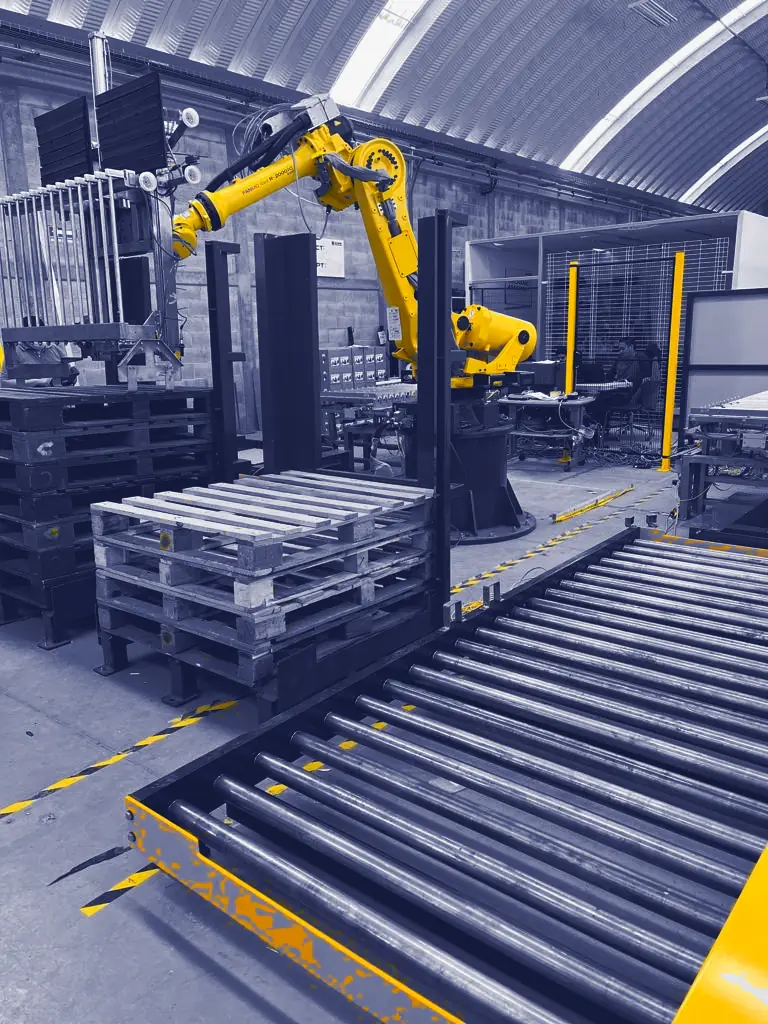
- Take manual handling off the job. A robotic palletizer takes over the repetitive task of lifting and twisting with each case or bag, and the person moves to supplying pallets and watching the cell. The tasks that remain, such as removing the full pallet, get scored again (item 7.6).
Target Robotics builds palletizers with a FANUC robot in San Luis Potosí, in 3 versions. The formula reads the claims experience of the whole employer registration. The March premium depends on every case that closes in the year, on the stacking line and in any other area.
What to ask human resources for before February
Four data points are enough to run this calculation for your plant:
- The work risks closed in the last three years, with subsidized days per case and per job, and the percentage of each permanent disability.
- The cases open today and their likely discharge date.
- The current premium and the average number of workers in the last declaration.
- The average contribution base salary.
Add up the subsidized days from the stacking jobs and multiply them by 2.3 and by the average base salary: that is the order of magnitude those cases added to the contribution. The palletizer ROI calculator counts labor and leaves injuries out, so this line is added separately.
The 2027 declaration is filed in February and takes the cases closed through December 31, 2026.
Frequently asked questions
Is low back pain an occupational disease in Mexico?
How much does the risk premium rise after a work accident?
Do commuting accidents raise the risk premium?
When is the work risk premium declaration filed?
Does a robotic palletizer lower the risk premium?
Sources
- Social Security Law (Ley del Seguro Social), current text with last amendment on Jan 15, 2026, Chamber of Deputies, checked Nov 27, 2026 (in Spanish)
- Regulation of the Social Security Law on Enrollment, Classification of Companies, Collection and Auditing (RACERF), last amendment on Jul 15, 2005, checked Nov 27, 2026 (in Spanish)
- Federal Labor Law (Ley Federal del Trabajo), current text with last amendment on May 14, 2026, Chamber of Deputies, checked Nov 27, 2026 (in Spanish)
- DOF, decree amending Articles 513, 514 and 515 of the Federal Labor Law, with the table of occupational diseases and the disability valuation table, Dec 4, 2023 (in Spanish)
- IMSS, 2025 Statistical Report, chapter VII, occupational health, checked Nov 27, 2026 (in Spanish)
- IMSS, 2025 Statistical Report, chapter X, cash benefits, checked Nov 27, 2026 (in Spanish)
- IMSS, Report to the Federal Executive and Congress 2025-2026, chapter III, work risk insurance, checked Nov 27, 2026 (in Spanish)
- IMSS, press bulletin 246/2018 on low back pain consultations, Oct 3, 2018 (in Spanish)
- STPS, Trabajo Seguro bulletin no. 86, the cost of work accidents and diseases, with 2017 data, checked Nov 27, 2026 (in Spanish)
- NOM-036-1-STPS-2018, manual handling, DOF, Nov 23, 2018 (in Spanish)