

Case palletizer robot for plants in Mexico
Corrugated, trays and packs, from 3 to 50 kg. To palletize cases with no manual handling on any shift.
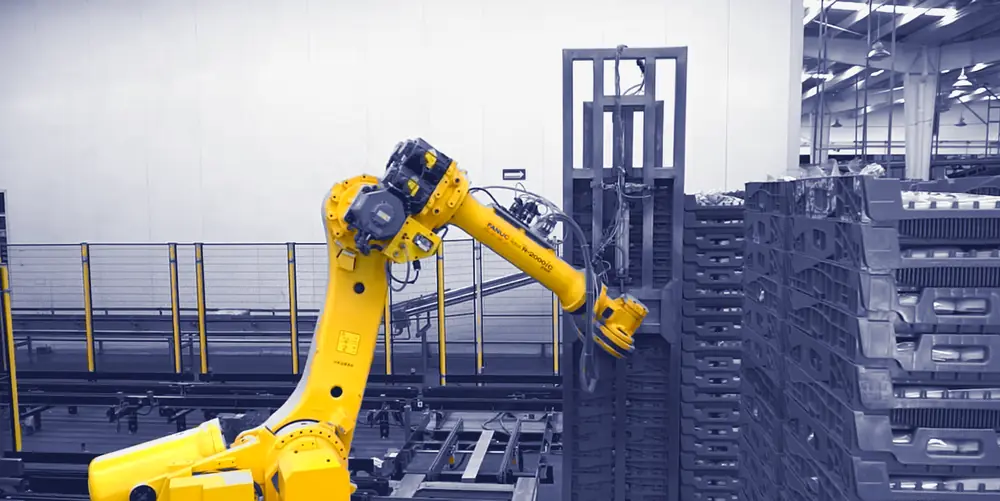
A case palletizer robot picks one or several cases at a time and places them on a pallet in a programmed pattern. Target Robotics builds it in San Luis Potosí with FANUC robots: in installed systems it has reached 60 cases per minute (Target presentation, 2026) and cases from 3 to 50 kg (MMS México, 2017).
- Load
- 3 to 50 kgMMS México, 2017
- Speed
- Up to 60 cases per minuteTarget presentation, 2026
- Space
- About 6 x 6 m with fencingOrder of magnitude. The layout comes from your load and your floor
- Public price
- US$120,000 to US$550,000CSi and Kaufman, November 3, 2026
- Delivery
- 12 weeksLead time confirmed by Target, November 2026
Three pallet patterns
A 40 x 30 cm case on a 120 x 100 cm pallet. The pattern changes how many fit and how firmly the load travels.
Column stack
9 cases. The corners of each case bear on the ones below, and it is the pattern that best withstands compression. The layers are left untied: it needs more stretch film or slip sheets.
Interlocked
10 cases. It uses the whole pallet and the next layer goes reversed. We use it almost all the time, and you need it if the load travels by truck.
Pinwheel
Four blocks around a gap. It works when the case does not fill the pallet with the other two; it ties the load well, but leaves a gap in the center. Shown here with a 34 x 26 cm case.
How many boxes fit on a pallet?
1.20 x 1.00 m pallet, total height of 1.80 m. No overhang.
| Case (cm) | Pattern | Per layer | Layers | Total |
|---|---|---|---|---|
| 40 x 30 x 26 | Interlocked | 10 | 6 | 60 |
| 60 x 40 x 30 | Interlocked | 5 | 5 | 25 |
| 30 x 20 x 20 | Interlocked | 20 | 8 | 160 |
| 50 x 30 x 25 | Column stack | 8 | 6 | 48 |
| 45 x 35 x 30 | Interlocked | 6 | 5 | 30 |
Target Robotics geometric calculation, made with the calculator on this site. You still need to check the compression of your case and the maximum weight of your pallet.
What defines the machine
Speed
One case per pick is enough for slow lines. For 60 cases per minute, rows are formed and the robot picks several at a time.
Weight and strength
A weak case calls for careful vacuum or a pick from below. A 50 kg case calls for a higher-payload robot.
Product changeovers
If you run several sizes, each one has its pattern in the program and the changeover takes minutes.
Number of lines
One cell can serve several lines: Target has built a system on 6 lines.
Questions about case palletizing
How do you palletize boxes?
How many boxes fit on a pallet?
How do you stack boxes on a pallet so they do not fall?
What does palletizing boxes mean?
Can one palletizing robot serve several lines?
How much does a case palletizer robot cost?
Send your case size and your speed. We reply with a version and a price range.
Delivered in 12 weeks. Public price reference: US$120,000 (CSi) to US$550,000 (Kaufman), as of November 3, 2026.
Or call sales: +52 (444) 279 0953 · WhatsApp
- 1What you palletize
- 2At what speed
- 3How many lines
- 4Your pallet
- 5How many shifts
- 6Space and city