

How many lines can one palletizing robot serve, and how to run the numbers
Published figures run from one to five lines per robot: Currie talks about two to five on average (2016) and other manufacturers publish up to three or four. The number for your plant comes from adding up the picks per minute of all the lines and comparing them with the speed the robot sustains in that cell.
- Topic
- Comparisons
- Reviewed
- November 13, 2026
- Reading time
- 8 minutes
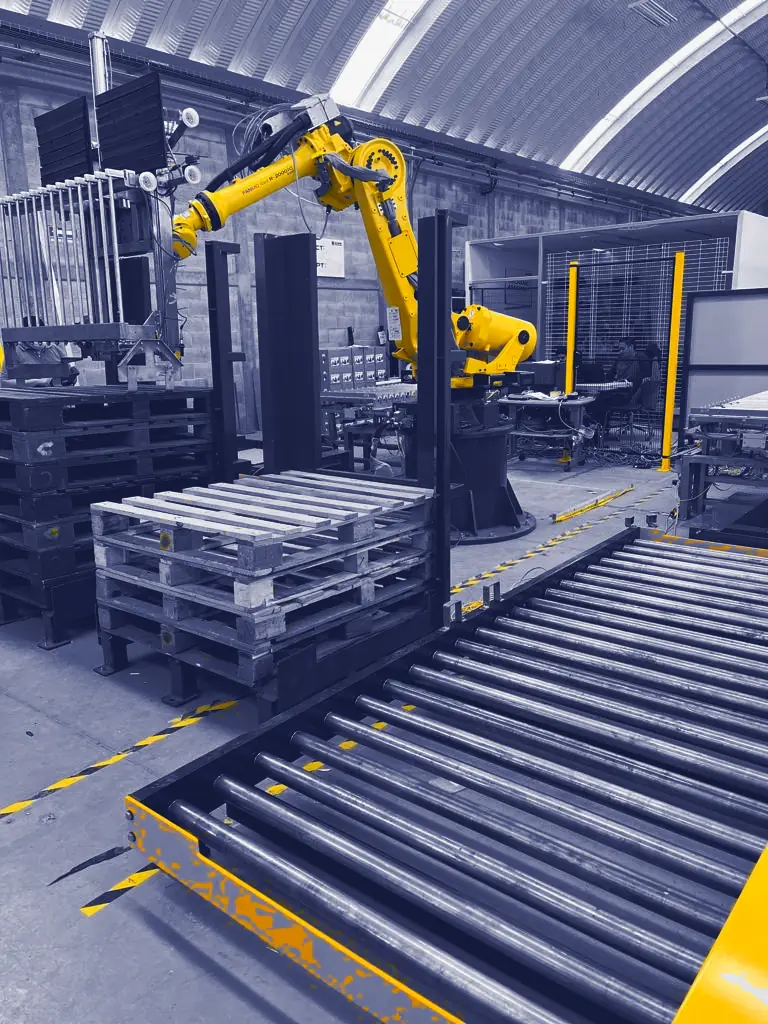
A palletizing robot can serve several lines as long as their combined picks per minute fit within its cycle. Currie published two to five lines per robot on average (Packaging Strategies, 2016) and Intelligrated, up to four in-feeds with a load-building station (Material Handling 24/7, 2017). FANUC publishes 2,200 cycles per hour for the M-410iC/110 (2026). For plants in Mexico, Target Robotics has built a system serving 6 lines (corporate presentation, 2026).
In this article
Three packaging lines end a few meters from one another, and at the end of each one somebody is stacking by hand. Whoever draws that plant ends up asking how many lines one palletizing robot can serve: three cells will not fit in the aisle, and a single one looks small for that much product.
Manufacturers answer with different numbers, almost always with a condition attached. Here are the ones we found published, the math to apply them to your lines and the signs that a line needs its own robot.
How many lines can one palletizing robot serve
| Who publishes it | What it says | Condition or context | Date |
|---|---|---|---|
| Currie, in Packaging Strategies | Two to five lines per robot, on average | Article by Jason Bennett, palletizing product line manager, on cells with multiple infeeds | June 13, 2016 |
| Intelligrated, in Material Handling 24/7 | Up to four in-feeds and load-building stations on one robotic palletizer | With its IntelliGen software | March 7, 2017 |
| Rivas Robotics, Spain | Configurations for 1 line, 2 lines and 3 or 4 lines | It publishes the case of one robot serving 3 lines | Checked November 13, 2026 |
| HM Healy, Mexico | Up to 3 lines with 1 robot, depending on line speed | Cell with a KUKA robot of 180 or 240 kg | Checked November 13, 2026 |
| Premier Tech, RPL-1000 series | 1 infeed conveyor and 1 or 2 stacking positions | Its entry-level robot: up to 20 units per minute, pallet change excluded | Brochure from September 2025 |
| FANUC | An M-410 palletizing rolls and cases from two infeed conveyors | Example on its palletizing page, with common tooling | Checked November 13, 2026 |
| Target Robotics | A system serving 6 lines | Corporate presentation. The figure describes the system and does not say how many robots it has | 2026 |
Published figures run from one to five lines per robot, and nearly every one carries its condition, such as line speed or the software that assigns the picks. FANUC writes on its page that its palletizing robots can be programmed to handle multiple infeeds and different SKUs on the same line (checked November 13, 2026). The number of lines comes out of the cycle math, and that math is done with your plant’s speeds.
The Target Robotics figure describes a complete system: the case studies page lists it at 60 cases per minute, coming from six lines into one system (Target’s corporate presentation, 2026).
What decides whether one robot is enough for several lines?
- The combined speeds. The robot splits its cycles among the lines. As a reference for what is published for an industrial robot: 2,200 cycles per hour on the M-410iC/110 (FANUC America spec page, which does not state the payload or the travel); up to 30 cases per minute, depending on the robot and the application (FANUC); up to 30 products per minute on the CSi i-Pal, depending on product and gripper; and up to 25 cases, 15 bags or 14 bundles per minute at Rivas Robotics. All checked November 13, 2026.
- Cases per pick. A gripper that takes two cases per trip handles 10 cases per minute with 5 picks. Forming rows before the pick frees up cycles for another line.
- The travel. The FANUC catalog gives 2,403 to 3,143 mm of reach for the M-410 models from 110 to 315 kg (RM-410(E)-03, November 2025). The pick points of every line and their pallets have to fit within that radius, and every meter of travel uses up cycle time.
- The extra work for the arm. If the same robot places the empty pallet or the slip sheet, those trips come out of the same cycle. Premier Tech states in its brochure that its rate leaves out the pallet change.
- Priority among lines. In its article on one robot with three lines, Rivas Robotics writes that software manages the pick-up priorities and that, if all three run at full capacity at the same time, sizing the robot correctly is crucial to avoid bottlenecks (September 7, 2025).
One robot is enough for several lines as long as the combined picks per minute fit within its cycle, with margin for pallets and slip sheets.
How do I run the numbers for my lines?
There are four steps:
- Write down the cases per minute of each line at its peak, with the fastest product.
- Define how many cases the gripper takes per trip on each line.
- Divide the first by the second and add up the lines: that gives the picks per minute the robot has to sustain.
- Add up the pallets per hour. Every finished pallet calls for an exit and an empty pallet.
An example with three lines (Target Robotics calculation with assumptions; swap in your own numbers):
| Line | Cases per minute at peak | Cases per pick | Picks per minute | Pallets per hour, at 40 cases per pallet |
|---|---|---|---|---|
| A | 10 | 2 | 5 | 15 |
| B | 8 | 2 | 4 | 12 |
| C | 6 | 1 | 6 | 9 |
| All three | 24 | 15 | 36 |
The three lines call for 15 picks per minute, 900 per hour, and deliver 36 pallets per hour: one finished pallet every 100 seconds, spread over three stations. The 15 picks sit below the 2,200 cycles per hour FANUC publishes for the M-410iC/110, almost 37 per minute. Between one number and the other are the travel in your cell, the pallet change and the slip sheets, and the spec page does not say whether it counts them.
Compare your total against the speed the supplier commits to with all lines running and the pallet change included. The pattern and the cases per pallet for each product come from the cases-per-pallet calculator.
When does a robot per line make more sense?
| Sign in your plant | Points to one robot for several lines | Points to a robot per line |
|---|---|---|
| Combined picks per minute | Fit with margin within the committed speed | Exceed that speed or leave it with no margin |
| Distance between lines | The line ends fit within the reach of the robot | Lines in separate buildings or aisles |
| Stoppages | You can accumulate product or stack by hand for a few minutes | No line can wait for the others |
| Products | One gripper handles every format | Formats that call for different grippers |
| Growth | The lines will keep running at similar speeds | One line is going to double its speed |
A line that has to run even when the others stop calls for its own robot.
The Currie article shows both outcomes. In one photo, four robotic cells, each handling two lines, wait for their factory acceptance test. In another, a customer wanted to consolidate three lines into one palletizer and the best solution was a conventional one, based on budget, ROI, volume and pack pattern. The comparison between the two machines is in robot vs. conventional palletizer.
On accumulation there are two published readings. Currie writes that robotic palletizers do not require accumulation conveyors, and counts that as a large saving. Rivas Robotics, in its three-line cell, brings the products through conveyors and accumulation systems to a common pick-up zone. Ask which of the two applies at your speed.
What changes in price and in payback?
Rivas Robotics publishes turnkey prices, from Spain: 95,000 to 150,000 euros for one or two lines and 150,000 to 250,000 euros for several lines or formats in the same cell (checked November 13, 2026). We did not find a public price by number of lines in Mexico. The references for a complete cell are in robotic palletizer price.
On payback, the people on each line add up. Three lines with one person per shift at 3 shifts make 9 people on payroll, and in the table in when a robotic palletizer pays off that operation falls between the rows for 8 and 12 people. Several small lines, added together, can justify the cell that none of them justifies alone. The payback calculator runs your case.
What to ask the supplier of a multi-line cell
- The sustained speed of each line, with all of them fed at once and the pallet change included.
- The layout with the reach of the robot, the pick points and the pallet positions.
- What each line does when the robot stops and how many minutes of accumulation it has.
- How many formats the gripper handles and how long a changeover takes.
- The priority rule among lines, in writing.
- The factory test with all lines fed. The other line items are in how to compare palletizer quotes.
The robot models and their reach are in FANUC M-410 palletizing robot models, and the cell for cases is in case palletizer robot.
For the first call, bring for each line the cases per minute at peak, the weight and dimensions of the case, the cases per pallet and the stack height. From the plant, one more number: the meters between one line end and the next.
Frequently asked questions
Is one robot enough for all my lines?
I have three slow lines. Can I bring them into a single cell?
What happens to the other lines if the robot stops?
Can one robot build pallets of different products at the same time?
Is one robot for several lines cheaper than a robot per line?
Sources
- Packaging Strategies, article by Jason Bennett (Currie) on multiple infeed palletizing, June 13, 2016, checked November 13, 2026
- Material Handling 24/7, article on Intelligrated's IntelliGen software, March 7, 2017
- Rivas Robotics, palletizing robot, checked November 13, 2026 (in Spanish)
- Rivas Robotics, one robot to palletize three lines, September 7, 2025 (in Spanish)
- HM Healy, robotic palletizing, checked November 13, 2026 (in Spanish)
- Premier Tech, RPL-1000 series brochure, September 2025 (in Spanish)
- FANUC America, palletizing page, checked November 13, 2026 (in Spanish)
- FANUC America, M-410iC/110 spec page, checked November 13, 2026
- FANUC Corporation, FANUC Robot M-410 catalog, RM-410(E)-03, November 2025
- CSi palletising, i-Pal, checked November 13, 2026