

Bags per hour for a palletizing robot, and how to match it to your bagger
Published figures run from 360 to 1,900 bags per hour for one robot, depending on the manufacturer and the gripper (Atlas Robots and BEUMER, 2026): up to 600 with forks, and up to 1,900 with a double finger gripper on bags that hold their shape. A two-spout bagger fills up to 900 bags of 25 kg per hour, and a rotary valve bagger, 1,000 to 6,000.
- Topic
- Pallets and stacking
- Reviewed
- November 23, 2026
- Reading time
- 8 minutes
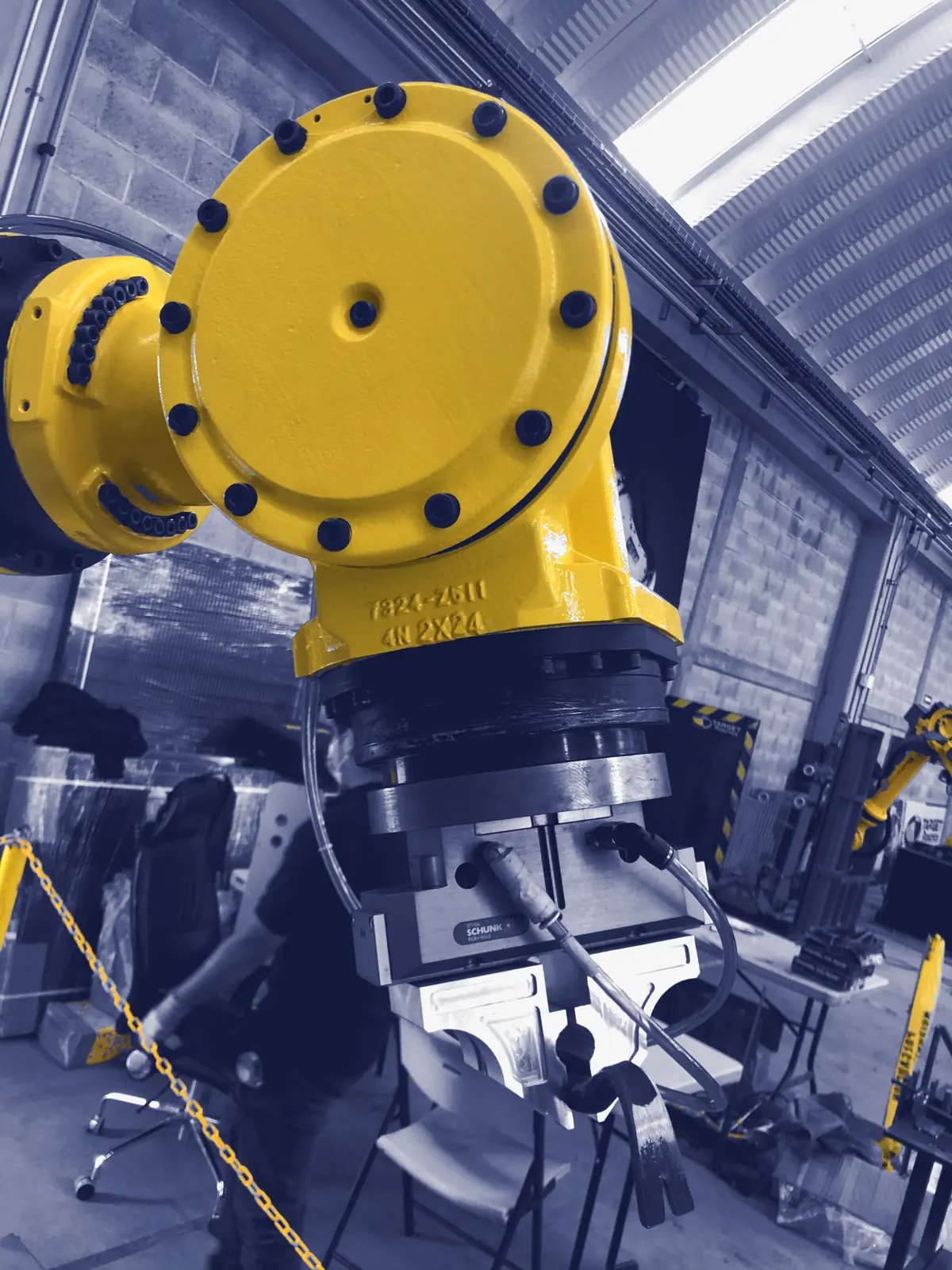
A robot palletizes 360 to 1,900 bags per hour according to what Atlas Robots, Rivas Robotics, Premier Tech and BEUMER publish (2025 and 2026); the gripper sets the figure. A two-spout open-mouth bagger fills up to 900 bags of 25 kg per hour (Premier Tech, 2026) and a rotary valve bagger, 1,000 to 6,000 (HAVER & BOECKER, 2026). Target Robotics builds the bag palletizer in Mexico with a FANUC robot.
In this article
- Bags per hour for a palletizing robot: published figures
- Why does the cell run fewer cycles than the robot spec sheet?
- How many bags per hour does your bagger fill?
- How do you match the robot to the bagger?
- Which gripper fits your bag?
- How many pallets per hour come out, and who changes them?
- How many people does that output take if stacked by hand?
- What to measure before you ask for a quote
A two-spout open-mouth bagger fills up to 15 bags of 25 kg per minute, according to Premier Tech’s January 2026 brochure. That is 900 bags and 22.5 tonnes every hour (Target Robotics calculation), and all of it ends up on a pallet.
Vendors publish bags per hour for a palletizing robot: 360 to 1,900, depending on the manufacturer and, above all, on the gripper. With that figure and your bagger’s, you can tell whether one robot is enough, whether a double gripper makes sense or whether the line calls for another machine.
Bags per hour for a palletizing robot: published figures
| Who publishes it | Configuration | Bags per hour | Date |
|---|---|---|---|
| Atlas Robots | Standard bag palletizer, bags from 1 to 120 kg | 360 | Updated Oct 29, 2026 |
| BEUMER robotpac | Fork gripper, any bag | Up to 600 | Checked Nov 23, 2026 |
| BEUMER robotpac | Double fork gripper, two bags per travel path | Up to 900 | Checked Nov 23, 2026 |
| Rivas Robotics | Robotic palletizer | Up to 15 per minute, 900 per hour | Checked Nov 13, 2026 |
| Atlas Robots | High-speed version | Up to 1,000 | Updated Oct 29, 2026 |
| BEUMER robotpac | Finger gripper, for bags that hold their shape | Up to 1,200 | Checked Nov 23, 2026 |
| Premier Tech | RPL-1000, one infeed | Up to 20 units per minute, 1,200 per hour, excluding the pallet change | Brochure from Sep 2025 |
| BEUMER robotpac | Double finger gripper, for bags that hold their shape | Up to 1,900 | Checked Nov 23, 2026 |
These are vendor figures and almost all of them say “up to”. On bags that hold their shape, BEUMER publishes 1,900 bags per hour with a double finger gripper; with forks, 600.
Why does the cell run fewer cycles than the robot spec sheet?
FANUC introduced the 185 kg M-410iC at 1,700 cycles per hour on its design cycle: raise the load 400 mm, travel 2,000 mm and lower it 400 mm. The same piece notes the figure changes with how long the pick takes (ZI, January 2014). For the M-410iC/110, FANUC publishes 2,200 cycles per hour without stating load or travel (FANUC America spec sheet, checked November 13, 2026), and in a 2017 demonstration it showed the robot at 32 bags per minute (announcement of September 25, 2017).
Bag cells publish 360 to 1,900 bags per hour, and with a double gripper each cycle places two: 1,900 bags are 950 cycles. The gap with the spec sheet comes from what the design cycle leaves out:
- Picking and releasing. Forks slide under the bag and pull out to set it down.
- Long travel. Far pallet corners and upper layers stretch the trip.
- Preparing the bag. FANUC shows cells where bags get flattened and inspected before they reach the robot (palletizing page, checked November 13, 2026).
- The pallet change. Premier Tech publishes its 20 per minute without it.
The figures for each model in the series are in which FANUC robot is used for palletizing. Ask for the figure in bags per hour with your line’s bag and pattern, pallet change included.
How many bags per hour does your bagger fill?
| Bagger | Bags per hour | Source |
|---|---|---|
| Open mouth (CHRONOS OMP-1045 B), bags from 10 to 50 kg | Up to 450; the brochure says 7 per minute | Premier Tech, Jan 2026 |
| Open mouth with two spouts (CHRONOS OMP-2090 B), 25 kg bags | Up to 900, 15 per minute | Premier Tech, Jan 2026 |
| Rotary for film bags, up to 10 spouts (ROTO-PACKER RS) | 400 to 1,200 | HAVER & BOECKER, checked Nov 23, 2026 |
| Rotary for valve bags, up to 16 spouts (ROTO-PACKER RV) | 1,000 to 6,000 | HAVER & BOECKER, checked Nov 23, 2026 |
Premier Tech notes that its figure depends on the application, the bags and the configuration. Your line’s figure comes from counting bags over a full shift, with its stops and roll changes.
Measure your bagger in bags per minute sustained over a shift; that figure sizes the cell.
How do you match the robot to the bagger?
A cell running exactly at the bagger’s speed needs a margin to recover from a stop. An example, in a Target Robotics calculation with assumptions: the cell stops for 5 minutes with the bagger at 15 bags per minute, and 75 bags pile up. To clear them in 15 minutes while the bagger keeps running, the cell has to run at 20 per minute, a third faster. Below, the ranges with that third are rounded.
Those 75 bags need somewhere to wait. With 60 cm bags in a single file, every minute of stoppage at 15 per minute takes up 9 m of conveyor, and the 5 minutes, 45 m. If the conveyor does not have those meters, the bagger has to stop along with the cell.
With that one-third margin, the two tables line up like this:
| Your bagger | Bags per hour | With a one-third margin | What is published in that range |
|---|---|---|---|
| Open mouth, OMP-1045 B | Up to 450 | 600 | Fork gripper, 600 (BEUMER); high speed, 1,000 (Atlas). The standard Atlas cell, at 360, falls short |
| Open mouth with two spouts, OMP-2090 B | Up to 900 | 1,200 | RPL-1000, 1,200 (Premier Tech); on bags that hold their shape, finger gripper, 1,200, or double finger, 1,900 (BEUMER). Double fork and Rivas publish 900, with no margin |
| Rotary for film bags | 400 to 1,200 | 530 to 1,600 | On bags that hold their shape, finger gripper, 1,200, or double finger, 1,900 (BEUMER) |
| Rotary for valve bags | 1,000 to 6,000 | 1,330 to 8,000 | One robot with a double finger gripper, up to 1,900. Above that, a layer palletizer: BEUMER paletpac publishes 1,800 to 6,000 bags per hour for robust product and 600 to 2,500 for sensitive product; or two cells |
Ask for the speed margin and the meters of accumulation conveyor in the quote.
If two bagging lines end near each other, one robot can serve both as long as their combined bags fit in its cycle. The step-by-step math is in how many lines one palletizing robot can serve. When a layer palletizer makes more sense is laid out row by row in robot vs conventional palletizer.
Which gripper fits your bag?
BEUMER sorts its grippers by bag type (checked November 23, 2026). Forks slide under any bag and reach 600 per hour, or 900 with double forks. The finger gripper is for filled bags that hold their shape: 1,200 per hour, and 1,900 in the double version. FANUC shows an M-410iC with forks for 50-pound bags, about 23 kg (palletizing page, checked November 13, 2026).
Vacuum grips poorly on woven polypropylene or porous paper, which is why the bag gets lifted from below. With 50 kg bags, a double gripper carries 100 kg plus its own weight: ask in writing for the robot model and its payload with the gripper on. By hand, that bag exceeds the 25 kg cap in NOM-036.
Bring three filled bags from your line to the first meeting to choose the gripper with them.
How many pallets per hour come out, and who changes them?
With 25 kg bags of about 60 x 40 cm, the usual pattern is 5 bags per layer on a 1.00 x 1.20 m pallet; with 8 layers, 40 bags per pallet. At 900 bags per hour, 22.5 pallets come out per hour, one every 2 minutes 40 seconds (Target Robotics calculation with assumptions).
At that pace, the forklift makes 22.5 trips per hour, and the cell needs somewhere to build the next pallet while the full one is taken away. The CSi s-Pal, a case cell, comes with 2 floor pallet positions (brochure from September 29, 2026). Ask in writing how many people per shift the cell needs, whether it includes an empty pallet dispenser and how the full pallet leaves. How much width the second position adds and what floor the cell needs is in robotic palletizing cell: components, footprint and utilities.
How many people does that output take if stacked by hand?
NOM-036-1-STPS-2018, Mexico’s federal standard on manual handling, caps manual lifting at 25 kg for men aged 18 to 45 and at 20 kg for women of that age, and cumulative mass at 10,000 kg per 8-hour shift, under 10 m. Read per person, which is the cautious reading, in a Target Robotics calculation with 25 kg bags:
| Bagger | Bags per 8 h shift | Kilos per shift | People under the cumulative mass cap |
|---|---|---|---|
| Up to 450 per hour | 3,600 | 90,000 | 9 |
| Up to 900 per hour | 7,200 | 180,000 | 18 |
At 3 shifts of 8 hours, that is 27 and 54 people a day, and with a 25 kg bag, Table 1 of the standard only lets men aged 18 to 45 carry it. What that crew costs is in cost of manual palletizing in Mexico; how to stack by hand and how the task scores, in how to stack 25 kg bags. The full standard is in NOM-036: manual handling limits in Mexico.
What to measure before you ask for a quote
- Sustained bags per minute for each bagger, over a full shift.
- Bag type: valve, sewn open mouth or film; woven polypropylene, paper or plastic.
- Weight and dimensions of the filled bag, and whether it holds its shape.
- Pattern and height: bags per layer, layers and pallet size.
- Bagger stops and meters of conveyor available before the cell.
- Space and pallet outfeed: forklift, conveyor or stretch wrapper.
The line data sheet puts the basics on one printable page. Target Robotics builds the bag palletizer robot in San Luis Potosí with a FANUC robot and publishes a 12-week lead time.
Frequently asked questions
How many bags per hour can a palletizing robot handle?
Can a robot keep up with a rotary cement bagger?
How many people does it take to stack a bagger's output by hand?
Is a gripper that picks two bags at once worth it?
Sources
- Atlas Robots, bag palletizer price, updated October 29, 2026 (in Spanish)
- BEUMER Group, robotpac robot palletizer, checked November 23, 2026
- BEUMER Group, paletpac layer palletizer, checked November 23, 2026
- Rivas Robotics, robotic palletizer, checked November 13, 2026 (in Spanish)
- Premier Tech, RPL-1000 series brochure, September 2025 (in Spanish)
- Premier Tech, CHRONOS OMP-B series bagger brochure, January 2026 (in Spanish)
- HAVER & BOECKER, ROTO-PACKER rotary packers, checked November 23, 2026
- ZI Ziegelindustrie International, FANUC M-410iC with 185 kg, January 2014
- FANUC America, M-410iC/110 spec sheet, checked November 13, 2026
- FANUC America, M-410iC/110 announcement on A3, September 25, 2017
- FANUC America, palletizing (in Spanish), checked November 13, 2026
- CSi palletising, s-Pal brochure, September 29, 2026
- NOM-036-1-STPS-2018, manual handling, DOF, November 23, 2018 (in Spanish)