

Robotic palletizing cell: its components, how much floor it takes and what it needs from your plant
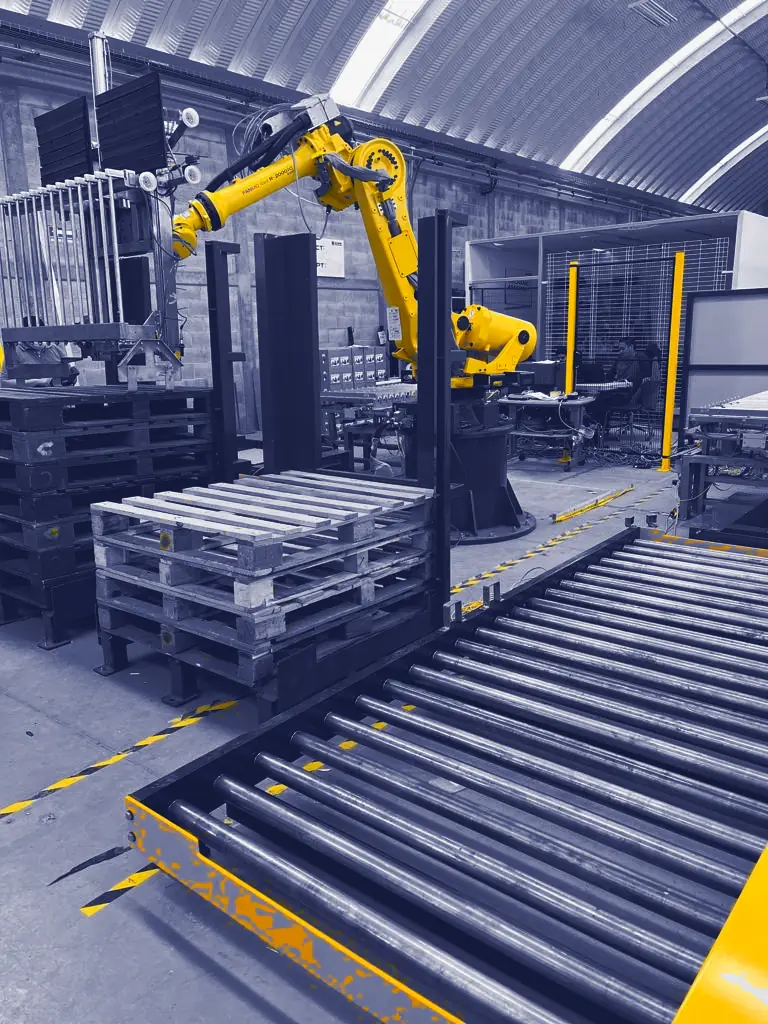
A robotic palletizing cell brings together the robot, gripper, product infeed, pallet stations, guarding and control panel in one space. With an industrial robot it takes 5.5 x 2.9 m to 6.35 x 6.45 m in the brochures checked, and with a cobot, from 2.3 x 1.4 m. The industrial version needs three-phase power, compressed air and a floor for more than a metric ton.
- Topic
- Comparisons
- Reviewed
- November 20, 2026
- Reading time
- 7 minutes
A robotic palletizing cell combines robot, gripper, infeed conveyor, pallet stations, guarding and control panel. In 2025 and 2026 brochures, cells with an industrial robot take 5.5 x 2.9 m (CSi s-Pal) to 6.35 x 6.45 m (Premier Tech, two pallets), and cobot cells start at 2.3 x 1.4 m (CSi c-Pal). A FANUC M-410iC/185 weighs 1,330 kg. Target Robotics, a Mexican palletizer manufacturer, gathers what is published.
In this article
- What components does a robotic palletizing cell have?
- How much floor space does a palletizing cell take?
- One pallet position or two?
- Industrial robot or cobot: what changes in the cell?
- What power, air and floor does a palletizing cell need?
- Where do the fence and sensors go?
- What to bring so the cell can be drawn
Before the robot arrives, someone at your plant is going to paint a rectangle on the floor. To know how big, it helps to know what a robotic palletizing cell contains and how much space the ones that publish their dimensions take up.
Here are the components, six published footprints with their dates and the utilities the cell asks of your plant: power, air, floor and network.
What components does a robotic palletizing cell have?
| Component | What it does | What to ask |
|---|---|---|
| Robot | Picks the piece and places it on the pallet. At FANUC, the M-410 series runs from 110 to 800 kg at the wrist (catalog dated November 2025) | Which model, and with how much margin over gripper plus product weight |
| Gripper or end-of-arm tool | Holds the piece with vacuum, fingers or a clamp. FANUC shows a zoned vacuum gripper that also picks pallets and sheets | How many formats it handles and how long a changeover takes |
| Infeed conveyor | Brings product to the pick point and orients it | How many infeeds, and how much product it accumulates if the robot stops |
| Pallet stations | One or two positions where the load is built | Whether the robot keeps working while the full pallet leaves |
| Dispensers | Put empty pallets and slip sheets within the robot’s reach | How many empty pallets the stack holds |
| Full pallet outfeed | Takes it out of the cell by conveyor or forklift | Which way it leaves and who removes it |
| Guarding | Fence, light curtains or area scanners | What the cell’s risk assessment requires |
| Control panel and screen | Run the cell and change the stacking pattern | Who at your plant will be able to change a pattern |
FANUC describes these parts on its palletizing page: infeed and pallet stations, sheet and pallet dispensers, and the full pallet leaving the cell on its own. The complete palletizer, with its anatomy, is on the robotic palletizer page.
How much floor space does a palletizing cell take?
| Cell | Robot | Published footprint | Pallets | Published payload and rate | Date |
|---|---|---|---|---|---|
| Premier Tech, RPL-1000 series | FANUC | 6.35 x 6.45 m, 3.66 m high | 2 | Up to 20 units per minute, excluding pallet change | Brochure dated Sep 2025 |
| Premier Tech, RPL-1000 series | FANUC | 6.35 x 4.17 m, 3.66 m high | 1 | Same | Brochure dated Sep 2025 |
| CSi palletising, s-Pal | FANUC R-2000iC/125L | 5.5 x 2.9 m | 2, on the floor | Product of 50 kg maximum; up to 8 picks per minute | Sep 29, 2026 |
| APT, MOD-PAL, in FANUC’s catalog | FANUC CRX-30iA cobot | 3.61 x 3.76 m (142 x 148 inches) | Unspecified | 30 kg; up to 7 cases per minute | Checked Nov 20, 2026 |
| Pacteon, dual pallet, in FANUC’s catalog | FANUC CRX-30iA cobot | 3.10 x 2.06 m (122 x 81 inches) | 2 | 30 kg; 6 cases per minute | Checked Nov 20, 2026 |
| CSi palletising, c-Pal | FANUC CRX cobot | 2.3 x 1.4 m, 2.8 m high | 2, on the floor | Product of 30 kg maximum; up to 8 cycles per minute | Checked Nov 20, 2026 |
The metric figures for the cells published in inches are a Target Robotics conversion. By area, the industrial robot cells in the table run from 15.95 to 40.96 m², and the cobot cells from 3.22 to 13.56 m² (Target Robotics calculation).
The robot’s reach sets the upper limit on size. A FANUC M-410iC/185 reaches 3,143 mm, according to its spec page: turning on its base it sweeps a circle about 6.3 m across (Target Robotics calculation), close to the 6.35 m length Premier Tech publishes. A cell can come in smaller than that circle: the s-Pal measures 5.5 x 2.9 m with a FANUC R-2000iC/125L.
Aisles, maintenance access and pallet stacks get added on top of the brochure footprint.
BW Packaging says to count infeed and outfeed conveyors, pallet dispensers, stretch wrapper, guarding, maintenance access and staging areas for empty and full pallets (May 18, 2026). With all of that, it gives 15 x 15 to 25 x 25 feet or more as a typical complete cell, about 4.57 x 4.57 m to 7.62 x 7.62 m.
One pallet position or two?
With two positions, the robot builds one pallet while someone removes the other. With one, the cell waits for the change. Premier Tech says so in its brochure: its rate of 20 units per minute excludes the pallet change.
The second position costs floor space. In the RPL-1000 series, going from one position to two takes the cell from 4.17 to 6.45 m wide: 2.28 m more (Target Robotics calculation with its brochure). With a single position, the published rate drops every time the pallet gets changed. If your cell will take product from more than one line, also see how many lines one palletizing robot can serve.
The empty pallet stack takes space too: BW Packaging puts it typically at 10 to 15 pallets high. For the infeed, it recommends planning at least 30 to 60 seconds of accumulation at the line’s rate.
Industrial robot or cobot: what changes in the cell?
| Item | With an industrial robot | With a cobot |
|---|---|---|
| Weight per piece | Product of 50 kg maximum on the s-Pal; M-410 robots from 110 to 800 kg at the wrist | 30 kg maximum on the three cobot cells in the table |
| Published rate | From 8 picks per minute (s-Pal) to 20 units per minute (RPL-1000) | From 6 to 8 per minute |
| Guarding | Fences, light curtains and FANUC dual check safety, standard on the RPL-1000 | Area scanners in place of a perimeter fence on the MOD-PAL |
| Area | 15.95 to 40.96 m² | 3.22 to 13.56 m² |
| Power | R-30iB Plus controller at 200 to 575 V, three-phase | 120 V and 20 A on the MOD-PAL |
The weight of the piece with its gripper and the line’s rate decide the type of cell, and with it, the floor space. The full comparison is in cobot vs industrial robot, and the robot models, in FANUC M-410 palletizing robot models.
What power, air and floor does a palletizing cell need?
| Utility | What is published | Source and date |
|---|---|---|
| Industrial robot power | R-30iB Plus controller: 200 to 575 V AC, three-phase, 50/60 Hz. The M-410iC/185 draws 3 kW on average | Controller data sheet, 2024; robot spec page, checked Nov 20, 2026 |
| Complete cell power | RPL-1000: 460 V, three-phase, 60 Hz, with other voltages available. Vention industrial palletizer with a FANUC robot: 500 to 575 V and 3.5 kVA | Premier Tech, Sep 2025; Vention, Mar 25, 2025 |
| Cobot cell power | 120 V, single-phase, 60 Hz and 20 A | StackOrder, 2024 sheet |
| Compressed air | 14 SCFM, ideal 6 bar, 4.5 to 7 bar (Vention); 8 CFM at 80 PSI (StackOrder) | Same data sheets |
| Floor | M-410iC/185: 1,330 kg. Atlas Robots: B25 concrete or better, no civil works | FANUC; Atlas Robots, Oct 29, 2026 |
| Network | The R-30iB Plus talks to the line PLC over EtherNet/IP, PROFINET or EtherCAT, among others | Controller data sheet, 2024 |
We did not find in FANUC’s public documents the concrete thickness or anchoring an M-410 requires; your supplier’s foundation drawing gives that figure. Bring your service voltage and your compressed air pressure to the first site visit.
Where do the fence and sensors go?
In a cell with an industrial robot, the fence surrounds the zone where the arm moves. The pallet enters and leaves through openings protected by light curtains, and muting lets the pallet through without stopping the cell. The MOD-PAL, with a cobot, uses area scanners in place of a perimeter fence.
The distances, muting and documents to demand from the integrator are in palletizing cell safety requirements.
What to bring so the cell can be drawn
- The floor plan of the area with dimensions, columns, doors and forklift aisles.
- The clear height to the ceiling or the lowest beam.
- The product: dimensions, weight and pieces per minute at peak.
- The pallet: size, stack height and whether it uses slip sheets.
- Available voltage, air pressure and where the drops are.
- Which way the full pallet leaves and who removes it.
The line data sheet puts that data on one page, and the timing of each stage is in robotic palletizer lead time. Check the clear height too: Premier Tech’s single-position cell stands 3.66 m high.
Frequently asked questions
How much floor space do I need for a robotic palletizing cell?
What voltage does a palletizing robot need?
How much does a palletizing robot weigh, and what floor does it need?
Does a cobot palletizing cell need a fence?
Sources
- FANUC America, palletizing, checked November 20, 2026 (in Spanish)
- Premier Tech, RPL-1000 series brochure, September 2025 (in Spanish)
- CSi palletising, s-Pal brochure, September 29, 2026
- CSi palletising, c-Pal brochure, checked November 20, 2026
- FANUC America, Robot & Go, MOD-PAL by APT, checked November 20, 2026
- FANUC America, Robot & Go, Pacteon dual pallet palletizer, checked November 20, 2026
- FANUC America, M-410iC/185 spec page, checked November 20, 2026
- FANUC Corporation, FANUC Robot M-410 catalog, RM-410(E)-03, November 2025
- FANUC America, R-30iB Plus controller data sheet, 2024
- Bastian Solutions, StackOrder overview sheet, 2024
- Vention, industrial palletizer datasheet, March 25, 2025
- Atlas Robots, bag palletizer price, updated October 29, 2026 (in Spanish)
- BW Packaging, floor space requirements for palletizing systems, May 18, 2026