

Food industry palletizer: what to ask for by package, cold rooms and washdown
You specify it by the package the robot touches and by the environment of the area. If the gripper picks a bag, a pouch or a water jug, it touches primary packaging, and NOM-251 calls for food-grade lubricant on those parts. In cold rooms or washdown areas, check the operating temperature and the IP rating on the robot spec sheet first.
- Topic
- Operations and support
- Reviewed
- November 23, 2026
- Reading time
- 8 minutes
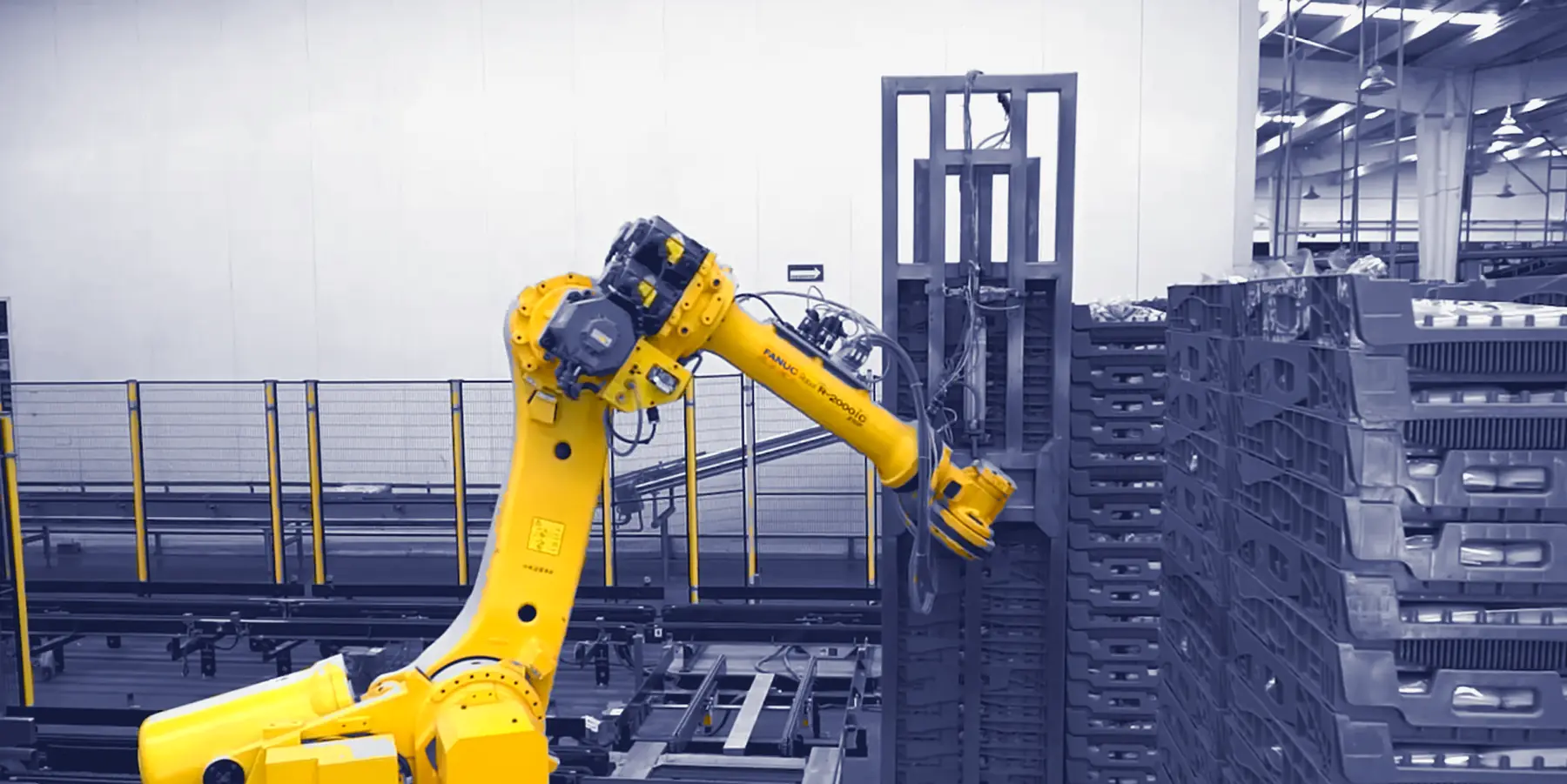
In Mexico, NOM-251-SSA1-2009 (DOF, 2010) calls for food-grade lubricant on parts that touch unpackaged product or primary packaging, such as a flour bag or a water jug. The FANUC M-410iC/185, a palletizing robot, is rated IP54 (FANUC America, 2026), and the series runs at 0 to 45 °C with no frost (FANUC catalog, 2020); KUKA publishes a palletizing version rated down to -30 °C. Target Robotics builds palletizers in San Luis Potosí.
In this article
- Food industry palletizer: what the robot touches
- What does NOM-251 ask of a robot that palletizes food?
- Can a palletizing robot work in a cold room?
- What IP rating survives washdown in your area?
- Corrugated cases in a humid area: what changes on the pallet?
- Many products on one line: what to ask of the program?
- What to send for a food palletizer quote
At a flour mill, the robot picks 25 kg bags; at a cookie plant, closed cases. NOM-251-SSA1-2009, Mexico’s federal standard on hygiene practices for food processing, treats the two differently: the bag holds the flour, and the case groups packs that come already sealed.
That difference, the temperature of the area, how it gets washed and the products that share the line all add rows to the quote for a food industry palletizer. Here is each point, with the standard or the spec sheet behind it.
Food industry palletizer: what the robot touches
The robot picks the package, and NOM-251-SSA1-2009 sets primary packaging, the one that holds the product, apart from the rest. That line decides what the standard asks of the cell.
| Package the robot picks | What it is under the standard | What to ask for in the cell | Where to read more |
|---|---|---|---|
| Closed corrugated case: cookies, snacks, dairy in cases | Secondary packaging | Suction cups or clamp; one pattern per product; slip sheets if the case is thin | How to palletize boxes |
| Shrink-wrapped bundle: water, soft drinks, beer | Secondary packaging | A tool that does not tear the film; row forming | Case palletizer robot |
| Bag of flour, sugar or milk powder | Primary packaging | Fork or clamp gripper; food-grade lubricant on the parts that touch the bag | Bags and sacks |
| Water jug, drum or pail | Primary packaging | Gripper by the neck or the body; the same lubricant on those parts | Pails and jugs |
| Tub or tray with unpackaged product | Unpackaged product | The whole tool and the robot fall under the hygiene rules | Your food safety program |
If the bag has an inner liner, that liner is the primary packaging and the robot touches the outer bag. When the tool picks a bag, a water jug or a pouch that touches the product, the cell falls under the hygiene rules for primary packaging. With closed cases, the differences from any other industry sit in the environment: cold, humidity and washdown.
What does NOM-251 ask of a robot that palletizes food?
NOM-251-SSA1-2009 was published in the DOF, Mexico’s official gazette, on March 1, 2010, and it binds anyone who processes food, beverages or supplements (section 1.2). Its section 5.9, “Maintenance and cleaning”, has four lines that apply to a palletizing cell:
- 5.9.1: equipment must be in good working condition.
- 5.9.2: after maintenance or repair, the equipment is inspected to remove residue, and it enters the production area clean and disinfected.
- 5.9.3: lubricating the equipment must avoid contaminating the products.
- 5.9.4: food-grade lubricants are used on equipment or parts in direct contact with the product, raw materials, primary packaging or unpackaged product.
On lubricant data sheets, food grade usually shows up as an H1 registration. The Society of Tribologists and Lubrication Engineers (STLE) puts it this way in its December 2019 magazine: H1 lubricants are used where there is some possibility of incidental food contact, and NSF registration guidelines for that category are modeled on 21 CFR 178.3570. H2 lubricants are for areas with no possibility of contact.
KUKA sells its KR QUANTEC PA palletizing robot in an HO version, with NSF H1 approved lubricant on all axes. At FANUC, the model with NSF H1 grease we found is the CRX-30iA Food Grade, a 30 kg cobot with white epoxy paint (both spec sheets checked November 23, 2026). For a palletizing robot from another line, ask in writing which lubricant each axis uses.
Ask for the data sheet of every lubricant on the gripper, the suction cups and the rollers, with its H1 registration, before you sign. Section 5.9.2 binds your plant: write into the contract that every supplier maintenance visit ends with cleaning the cell.
Can a palletizing robot work in a cold room?
FANUC’s catalog for the M-410iC series (July 2020) sets the installation environment as follows:
| Condition | What FANUC calls for |
|---|---|
| Temperature | 0 to 45 °C |
| Humidity | Normally 75% or less |
| Short-term humidity | Up to 95%, within one month |
| Dew and frost | The catalog rules both out |
A refrigerated room fits that temperature range. The concern is dew: humid air coming through the door condenses on the cold product and on the robot. A freezer room falls outside.
For that case there are purpose-built robots. KUKA publishes the Arctic version of its KR QUANTEC PA palletizing robot, rated down to -30 °C (checked November 23, 2026). The other route is to build the pallet before the cold room and move it in complete; the plant layout decides it. Also ask for the temperature range of the control panel and where it will sit.
If the pallet gets built inside the cold room, the robot spec sheet has to state that room’s temperature.
What IP rating survives washdown in your area?
The IP code has two digits: the first covers dust and the second, water. The RS Components guide to EN 60529 (September 8, 2026) describes them as follows:
| Digit | Value | Protection |
|---|---|---|
| First | 5 | Partial protection against dust |
| First | 6 | Full protection against dust |
| Second | 4 | Splashing from any direction |
| Second | 5 | Low-pressure jets, 6.3 mm nozzle |
| Second | 6 | Powerful jets, 12.5 mm nozzle |
| Second | 7 | Immersion up to 30 minutes, between 15 cm and 1 m |
| Second | 9K | High-pressure, high-temperature jets or steam cleaning, from ISO 20653:2013 |
The FANUC M-410iC/185 is rated IP54 on the body, wrist and J3 arm: partial protection against dust and against splashing. The CRX-30iA Food Grade is rated IP67 (FANUC America, spec sheets checked November 23, 2026).
Matched to your cleaning routine: with a wipe-down, a second digit of 4 covers splashing; with a hose, ask for 5 or higher; with a pressure washer, hot water under pressure or steam, 9K, or the manufacturer’s written confirmation. With flour or sugar in the air the first digit matters, and your safety team knows whether the area is classified for dust. The IP rating covers dust and water; resistance of paint and seals to your detergent is a separate request. The IP rating is specified separately for the robot, the control panel, the sensors and the gripper.
Conditions in the area also change the safeguards and where they go. What each safety standard requires is in palletizing cell safety requirements.
Corrugated cases in a humid area: what changes on the pallet?
A case loses strength with humidity. Roman Popil, of the Renewable Bioproducts Institute at Georgia Tech, cites the Fibre Box Association loss factors: at 80% relative humidity, box compression strength drops 32% against the same box at 50%. His formula gives a short rule, about 10% for every 10 points of humidity, and his note warns that above 50% the box becomes less predictable (May 2019). In a more humid room, test your case.
On a pallet of dairy or refrigerated product, that changes three things:
- The pattern. A column stack lines up the corners, which carry the weight. An interlocked stack ties the pallet together better and gives up part of that strength. The figures for each pattern are in how to palletize boxes.
- The height. It is calculated with the strength the case keeps at the humidity of your room. The cases per pallet calculator gives layers and weight for your case.
- The slip sheets. A sheet every few layers spreads the load when the case is thin.
At 80% relative humidity the case keeps about 68% of its strength, and that case sets the pallet height.
Many products on one line: what to ask of the program?
A cookie or snack line can run several SKUs in a single shift. The robot stores one pattern per product, and FANUC offers its PalletTool and PalletPRO programs for that (FANUC America palletizing page, checked November 23, 2026). Ask in writing:
- How many patterns the cell stores and who creates a new one: your team or the supplier.
- How long a product changeover takes and whether the gripper changes.
- What happens to a half-built pallet when the product changes.
If your customer asks for an SSCC pallet label, the pallet has rules too; in Mexico the standard is administered by GS1 México. As a reference, GS1 UK recommends two identical labels, one on a short side and one on a long side, 400 to 800 mm above the pallet base and no closer than 50 mm to the edge, with the SSCC in a GS1-128 barcode (reviewed November 5, 2024). They go on in the cell or after stretch wrapping; either way, the pallet has to arrive with those two sides within reach.
What to send for a food palletizer quote
With this data, whoever quotes can propose the cell from the first reply:
- Package the robot picks and whether it is primary: case, film bundle, bag, water jug or tub.
- Weight and dimensions of each product, and units per minute on each line.
- Temperature and humidity of the area where the cell goes, all year round.
- How the area gets cleaned: wipe-down, hose or pressure washer, and with which chemicals.
- Gripper and suction cup materials your food safety program accepts, and what your audit asks for on top of NOM-251.
- Products and patterns that run on the line, and how often they change.
- Pallet, height and label your customer asks for.
- Shifts and available space, with the floor plan if you have it.
The line data sheet puts the basics on one printable page.
On the tax side, the Plan México decree (DOF, January 21, 2025, Article Two) gives food and beverage a 67% immediate deduction in 2026 and 62% from 2027 to 2030, and grain milling, sugar and edible oils 56% and 49%, with a certificate. With a 12-week lead time, a cell ordered in December 2026 is delivered in 2027: confirm with your tax advisor which percentage applies to you. The full math is in Plan México immediate deduction.
Target Robotics, a Mexican palletizer manufacturer and authorized FANUC integrator, builds the cell in San Luis Potosí and publishes a 12-week lead time. By product, from cookies to water jugs, there is a table in robotic food and beverage palletizing in Mexico.
Frequently asked questions
What changes in a food industry palletizer?
Does a palletizing robot need food-grade lubricant?
Can a palletizing robot work inside a freezer?
What IP rating does a robot need if the area gets washed down?
Does the Plan México deduction apply to a palletizer for food?
Sources
- NOM-251-SSA1-2009, hygiene practices for food processing, DOF, March 1, 2010 (in Spanish)
- STLE, TLT Lubrication Fundamentals, incidental contact lubricants, December 2019
- FANUC, M-410iC series catalog, RM-410iC(E)-06, July 2020
- FANUC America, M-410iC/185 spec sheet, checked November 23, 2026
- FANUC America, CRX-30iA Food Grade spec sheet, checked November 23, 2026
- KUKA, HO robots with NSF H1 lubricant for the food industry, checked November 23, 2026
- RS Components, IP ratings guide under EN 60529, September 8, 2026
- Roman E. Popil, Georgia Tech, moisture and box compression strength, May 2019
- FANUC America, palletizing (in Spanish), checked November 23, 2026
- GS1 UK, where pallet labels go, reviewed November 5, 2024
- DOF, Plan México tax incentive decree, Article Two, January 21, 2025 (in Spanish)