

How long does an industrial robot last: mechanical, support and book life
The International Federation of Robotics computes its statistics with an average service life of 12 years (World Robotics 2026), and FANUC Europe stocks spare parts considering a service life that sometimes exceeds 30 years (2022). In the FANUC manual, the maintenance table ends with an overhaul at 8 years or 30,720 hours.
- Topic
- Operations and support
- Reviewed
- November 27, 2026
- Reading time
- 10 minutes
An industrial robot works while it has maintenance and spare parts. The IFR assumes an average service life of 12 years (World Robotics 2026); FANUC Europe stocks spare parts considering a service life that sometimes exceeds 30 years (2022), and the FANUC M-410iB/700 manual sets an overhaul at 8 years or 30,720 hours (2017). In Mexico, the Income Tax Law deducts food and beverage machinery at up to 8% a year. Target Robotics builds palletizers with a FANUC robot.
In this article
- How long does an industrial robot last, per IFR and FANUC?
- Where do the 80,000 to 100,000 hours come from?
- Mechanical life: the intervals in the FANUC manual
- What is a robot overhaul and when is it done?
- Support life: how many years of spare parts
- Are there robots with 27 years or more in service?
- Book life in Mexico: Article 35 of the Income Tax Law
- What extends and what shortens a robot’s life?
- What to ask when buying so the cell lasts
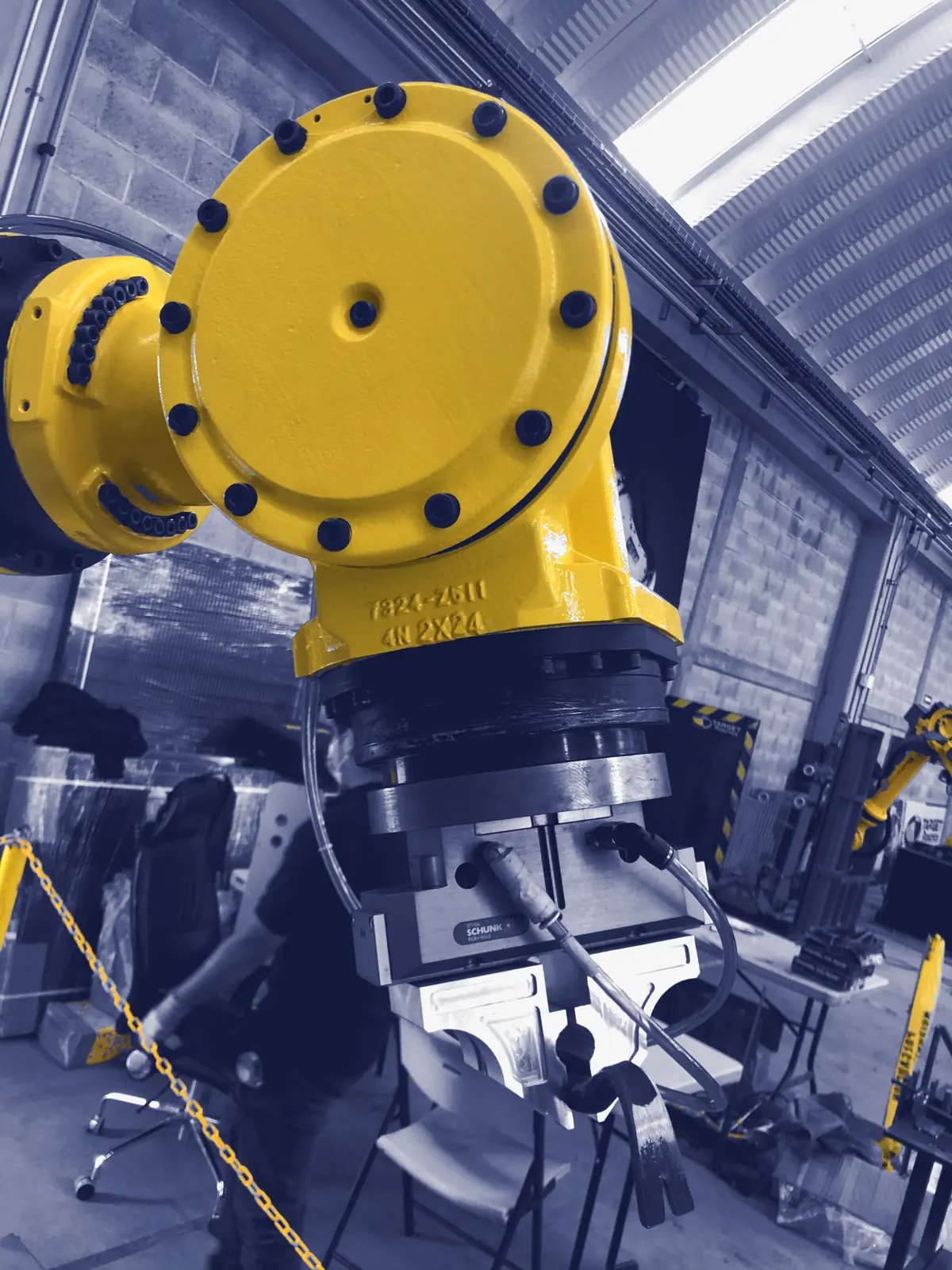
Eight years or 30,720 hours. That is where the periodic maintenance table ends in the FANUC manual for the M-410iB/700, a palletizing robot for 700 kg (B-82334EN/05, March 2017), and that last column holds a single word: “Overhaul”. The manual schedules work by hours and by years, and none of its pages sets a retirement date.
The question “how long does an industrial robot last” splits into three lives: mechanical, support and book. The ROI calculator counts the months until the purchase is recovered, and this article, the years that follow.
Target Robotics is a Mexican palletizer manufacturer and authorized FANUC integrator, which is why the manuals cited here are from that brand.
How long does an industrial robot last, per IFR and FANUC?
The International Federation of Robotics (IFR) computes how many robots are in operation by assuming an average service life of 12 years, with immediate withdrawal from service at that point (World Robotics 2026, Industrial Robots, section 1.6, page 31, September 2026). A pilot study by the IFR and the UN Economic Commission for Europe, carried out in 2000 among major manufacturers, found the 12 years conservative and an average closer to 15. The same page cites it.
FANUC Corporation writes on its service page that it provides “lifetime maintenance for its products as long as they are used by customers”, including models it has stopped producing (checked November 27, 2026). Bruno Fritschi, who signs as Director Customer Service at FANUC Europe, wrote on the IFR blog that the company stocks spare parts considering an average service life that sometimes exceeds thirty years (April 20, 2022).
The condition is in the manual: skipping the periodic inspection can affect the performance or the service life of the robot (B-82334EN/05, safety precautions).
| Life | Who sets it | Published figure |
|---|---|---|
| Mechanical | Manufacturer’s manual | Overhaul at 8 years or 30,720 hours (FANUC, 2017) |
| Support | Manufacturer’s spare parts and service | As long as the customer uses the product (FANUC, checked Nov 27, 2026) |
| Book | Income Tax Law, Article 35 | Maximum of 8% a year in food and beverage: 12.5 years (Target Robotics calculation) |
| Statistical reference | IFR | 12 years of average service life (World Robotics 2026) |
Where do the 80,000 to 100,000 hours come from?
The figure is repeated online as the industrial robot lifespan, and the trail we could follow leads to mean time between failures (MTBF): a column in The Robot Report signed by Steve Sickler of Tend.ai says some manufacturers advertise 40,000 to 100,000 hours of MTBF, and it names none of them (June 3, 2019). MTBF estimates how many hours pass, on average, between failures of a piece of equipment, and the same column attributes to data from more than 400 factories that 80% of the time the cell stops for causes unrelated to the robot. We found the figure in none of the manufacturer sheets or manuals we reviewed.
Mechanical life: the intervals in the FANUC manual
The FANUC manuals for the M-410iB/700 and the M-710iC (B-82274EN/12, June 2017) schedule maintenance by period or by accumulated operating hours, whichever comes first, and assume up to 3,840 hours of use a year. Above that figure they call for shortening the intervals in proportion: at 7,680 hours a year, each interval is divided by 2.
| Manual row (M-410iB/700 and M-710iC) | Interval | On 1 shift | On 2 shifts | On 3 shifts |
|---|---|---|---|---|
| Mechanical unit batteries | 1.5 years or 5,760 hours | 1.5 years | 1.2 years | 0.8 years |
| Reducer grease replacement | 3 years or 11,520 hours | 3 years | 2.4 years | 1.6 years |
| Mechanical unit cable and controller batteries | 4 years or 15,360 hours | 4 years | 3.2 years | 2.1 years |
| Overhaul | 8 years or 30,720 hours | 8 years | 6.4 years | 4.3 years |
The shift columns are a Target Robotics calculation with assumptions: 8 hours per shift, 6 days a week and 50 weeks a year give 2,400, 4,800 and 7,200 hours, with the robot running that whole time. The operation is the hours in the row divided by the hours per year: 30,720 ÷ 4,800 = 6.4 and 30,720 ÷ 7,200 = 4.3. On one shift, the period in years is reached first. On two shifts, the overhaul row in the manual arrives at 6.4 years; on three shifts, at 4.3.
For the arm batteries the shorter interval governs: FANUC America calls for replacing them every year (Tech Transfer, December 3, 2020). That difference and the tasks in each row, with their labor hours, are in FANUC robot preventive maintenance.
What is a robot overhaul and when is it done?
The manual marks the “Overhaul” row at 8 years or 30,720 hours and leaves its scope undetailed. Ask for the list of work before you contract it.
FANUC America does describe in public a robot recertification service with four processes: inspection, repairs to the mechanical unit or the controller, maintenance, and test and validation against original factory specifications. The axes or assemblies that fail the prior evaluation are fully disassembled (checked November 27, 2026). The same page says its robots often outlive the process they were bought for.
Yaskawa publishes its own measure for a robot overhaul: 36,000 servo hours as the primary lifecycle with regular maintenance, and at that point it offers to recondition the robot to original specification for another 36,000 hours (Yaskawa America blog, February 21, 2024). The IFR notes in its method that robots may be refurbished and that tax depreciation schedules underestimate their service life.
To decide when to replace a robot, compare that list of work and its price against a new cell with the same line data. If the robot you are offered has already been through that work, review what to ask for on a used robotic palletizer.
Support life: how many years of spare parts
FANUC publishes on the same service page the figures behind that commitment: about 80,000 repairs a year in Japan and more than 3.5 million pieces of 19,000 types of repair parts, with parts that have left production. When one runs out, it finds a substitute or redesigns it. It serves more than 100 countries from more than 280 service locations (checked November 27, 2026).
Fritschi gives the figures for Europe: local spare parts availability of 99.97% in 2021 and an average repair time under 20 hours, counted from the customer’s first call (IFR, April 20, 2022). Ask for the ones for Mexico, for your model and your controller.
A cell on two shifts accumulates 72,000 hours in 15 years and 96,000 in 20: 2.3 to 3.1 times the 30,720 hours of the overhaul row (Target Robotics calculation with the assumptions in the table). Every part replaced in that time has to exist for that model. FANUC writes that it maintains its products as long as the customer uses them, including the models it has stopped producing. Target Robotics has maintenance contracts; ask any supplier in writing which spare parts it keeps in Mexico.
Are there robots with 27 years or more in service?
Yes, and the manufacturers themselves document them. KUKA reports in its iiMagazine that a robot was being prepared for new tasks after 27 years and more than 27,204 operating hours at an automotive supplier (November 28, 2023). That is close to 1,000 hours a year, under half the 2,400 hours of one shift a year (Target Robotics calculation: 27,204 ÷ 27).
FANUC writes that its repair factory in Japan takes in products manufactured more than 40 years ago (checked November 27, 2026).
Book life in Mexico: Article 35 of the Income Tax Law
Machinery depreciation in Mexico is called deduction of investments in the Income Tax Law (Ley del ISR): the law authorizes maximum annual percentages of the original amount (Article 31) and, for machinery and equipment, sets them by the activity they are used in (Article 35; checked November 27, 2026). The decree published in the DOF, Mexico’s official gazette, on November 13, 2026, in force from January 1, 2027, leaves Article 35 as it was and adds an option for new assets.
| Activity the machine is used in | Maximum percentage per year (Art. 35) | Years to deduct it in full | Immediate deduction, 2027 to 2030 |
|---|---|---|---|
| Grain milling, sugar and its derivatives, edible oils | 5% | 20 | 49% |
| Food and beverage, except grains, sugar and oils | 8% | 12.5 | 62% |
| Chemicals, petrochemicals and pharmaceuticals; rubber and plastic | 9% | 11.1 | 65% |
| Other activities not specified | 10% | 10 | 67% |
The years in the third column are a Target Robotics calculation: 100 divided by the percentage. The last column is the immediate deduction in the transitional provisions of the Income Tax Law (Article Three of the same decree, part A, section I): for new fixed assets acquired from January 1, 2027 to September 30, 2030, a taxpayer may choose to deduct that percentage in the fiscal year of the investment, with a compliance certificate from the Evaluation Committee. The full math is in Plan México immediate deduction.
In food and beverage, machinery finishes its deduction at 12.5 years with the 8% maximum, half a year after the 12 the IFR assumes. An asset depreciated on the books has used up its deduction, and on the line it keeps working as long as it gets maintenance and has spare parts. This section summarizes the legal text; how it applies to your company is for your accountant to review.
What extends and what shortens a robot’s life?
The M-410iB/700 manual (B-82334EN/05, 2017) covers it row by row:
- Declared payload. It asks you to set the payload before the robot runs and to keep it within the allowable value, counting the cables and their swing; running over payload can reduce reducer life.
- Temperature. It specifies 0 to 45 °C ambient and states that, for an overheated motor, lowering the ambient temperature is the most effective measure.
- Grease on schedule. Among the causes of vibration and noise it lists grease left unchanged for a long time, which wears gears, bearings or the reducer through fatigue.
- Batteries and backup. Robot data, mastering data included, is kept by batteries and is lost if they run out, and the manual asks you to save programs and system variables periodically to a memory card or USB drive. The detail is in FANUC robot alarm codes and in FANUC robot backup.
Loading the robot within its declared capacity protects reducer life, per the FANUC manual. Target Academy gives 7 FANUC robot courses for whoever will do this work at the plant.
What to ask when buying so the cell lasts
The questions cover the whole cell, robot included:
- For how many years does the robot manufacturer publish spare parts and service for this model and this controller?
- Who provides service in Mexico, from which city and with what response time committed in the contract?
- What does the maintenance plan include and how does it adjust the interval table to the shifts on the line?
- Who performs the 30,720-hour overhaul, with what list of work and how many days of downtime for the cell?
- Do the gripper, the control panel and the conveyors use components with local spare parts?
The payback months by shifts and crew are in when a robotic palletizer pays off.
In a food and beverage plant on two shifts, the overhaul row in the manual arrives at 6.4 years. The IFR statistics stop counting the robot at 12 and the ordinary deduction ends at 12.5 (Target Robotics calculation with the assumptions in this article).
Frequently asked questions
How many years will an industrial robot last me?
My robot has passed 30,000 hours. What is due?
How often is the grease changed on a FANUC robot?
The robot is fully depreciated on the books. Do I have to replace it?
When does it make sense to replace a robot that is many years old?
Sources
- FANUC, M-410iB/700 mechanical unit operator's manual, B-82334EN/05, Mar 2017, public copy hosted by a third party
- FANUC, M-710iC mechanical unit operator's manual, B-82274EN/12, Jun 2017, public copy hosted by Haas
- FANUC America, Tech Transfer, FANUC Changing Batteries, Dec 3, 2020
- IFR, World Robotics 2026, Industrial Robots, chapter 1, section 1.6, page 31, Sep 2026
- FANUC Corporation, service page of its sustainability site, checked Nov 27, 2026
- IFR, blog post “Prepare to Repair”, Bruno Fritschi, FANUC Europe, Apr 20, 2022
- FANUC America, robot recertification, checked Nov 27, 2026
- Yaskawa America, blog post “B.I.G. Thoughts on Zero Maintenance”, Chris Caldwell, Feb 21, 2024
- KUKA, iiMagazine, “#HomeofRobotik: 50 years of robotics expertise”, Nov 28, 2023
- The Robot Report, column by Steve Sickler of Tend.ai on robot reliability, Jun 3, 2019
- Chamber of Deputies, Income Tax Law (Ley del ISR), last amended DOF Apr 1, 2024, checked Nov 27, 2026 (in Spanish)
- DOF, decree amending the Income Tax Law and issuing transitional provisions, Nov 13, 2026 (in Spanish)